
Updated: August 2025. This directory is designed to help you quickly find each curriculum and the supporting resources for music education and computer-assisted music.
You will find the weekly teaching hours: a three-hour elective in the first, second and final years of high school, and a specialist course of four hours in the second year and six hours in the final year. The regulatory references are included to help ensure compliance.
The service offers a clear home page and direct access to the “Download the curricula” documents, the supplementary curriculum and the prescribed curriculum. These French-language resources are part of the French national education system.
Intended audiences: students in general and technological high schools, and arts and music teachers, including teachers who combine computer-assisted music with other subjects.
Navigation is organized by grade level, educational pathway or need (assessment, teaching sequences, projects) to make both occasional consultation and yearly planning easier.
Overview of Éduscol’s directory of services for computer-assisted music and music education
A single entry point provides access to official frameworks, teaching materials and practical examples for music education and computer-assisted music. The home page directs users to the appropriate section according to grade level (middle school or high school) and document type.
The structure divides content into documents, videos and teaching scenarios. Each entry specifies the relevant curriculum, learning objectives and possible assessment methods. This makes access easier for teachers, students and French national education staff.
The resources connect perception and production. Four areas guide planning: singing, listening, exploring and discussing. Practical work engages the body and develops abilities, cultural knowledge and technical skills.
“Organizing materials by section and providing quick access to the curricula makes everyday classroom use more efficient.”
| Category | Content | Intended audience |
|---|---|---|
| Official documents | Reference texts, objective sheets | Teachers, staff |
| Videos | Demonstrations, filmed lessons | Students, teachers |
| Teaching scenarios | Learning plans, ready-to-use projects | Teachers |
Accessing resources and using Éduscol
The interface lets you select the desired section and grade level in just a few clicks.
On the home page, locate the filters for grade levels, then select the area you want. The menus let you sort by curriculum, document type or format.
Home page, sections and grade levels
The user journey has three steps: choose a grade level, select a section, then filter the documents or annual supplements.
- Public access: freely consult texts and examples.
- Quick route: access the curriculum, supporting resources or supplements.
Public access and features for staff
Some pages offer a feature intended for staff. To activate it, register or sign in as indicated.
French national education staff have access to restricted areas where they can add, save and share content.
Each item also includes a description, related links, and an assigned section and grade level.
“Adding this item to your selections makes it easier to track resources and reuse them in class.”
| Action | Purpose | Audience |
|---|---|---|
| Bookmark this item | Save it for later | Teachers, staff |
| Create selections | Organize resource tracking | French national education staff |
| Filter by grade level | Adapt materials to the educational stage | Teachers |
In short: structured access, sorting tools and the option to add this item to lists help save time when preparing lessons.
Official high school music curricula: frameworks, teaching hours and official bulletins
This framework clarifies teaching hours and requirements for each high school pathway. It helps teachers plan the school year and prepare lessons suited to their students.
Elective course (three hours per week)
The elective course meets for three hours a week in the first, second and final years of general and technological high school. This schedule allows a balance of practical work, listening and musical culture.
Specialist course (four or six hours)
The specialist course has four hours a week in the second year of general high school and six hours in the final year. These hours allow more time for projects, production and deeper technical study.
Regulatory references and updates
The official texts were published in Special Official Bulletin No. 1 of January 22, 2019, and Special Official Bulletin No. 8 of July 25, 2019. Updated: August 2025.
Supplementary documents for 2024–2025: the national supplementary curriculum (elective, final two years) and the prescribed curriculum for the final-year specialist course guide the choice of works and themes.
“Download the curricula,” then browse by section and grade level, remains the recommended way to ensure classroom compliance.
| Type | Hours | Purpose |
|---|---|---|
| Elective (first, second and final years) | 3 hours per week | Introduction, regular practice |
| Specialist course (second year) | 4 hours per week | Deeper technical and cultural study |
| Specialist course (final year) | 6 hours per week | Projects, preparation for higher education |
Content updates and publication schedule
To prepare for the new school year, follow the schedule of updates and supplements. The note “Updated: August 2025” identifies the latest available revision.

Updated documents: the texts from the 2019 Special Official Bulletins remain the foundation. They are supplemented by the national supplementary curriculum (final two years, 2024–2025) and the prescribed curriculum for the final-year specialist course in 2024–2025.
Check these files each year to make informed choices about works and themes. The release notes clearly indicate when an update has been made, including through the note “Updated: August 2025.”
Recommended process:
- Check the dedicated page.
- Download the curricula and supplements.
- Include new material in the yearly teaching plan.
Schedule a review at the end of the school year. This lets you adjust lessons, assessments and projects in light of new material and align supporting resources with the latest version of the curriculum.
| Document | Date | Purpose |
|---|---|---|
| Special Official Bulletin texts | 2019 | Regulatory framework, curriculum foundation |
| Supplementary curriculum | 2024–2025 | Choice of works, final two years |
| Prescribed curriculum | 2024–2025 | Final-year specialist course, prescribed list |
Music education resources: singing, listening, exploring and discussing
Music teaching today emphasizes the connection between perception and production in the classroom. The materials show that perceiving and producing work together to develop lasting skills.
Fundamentals: perception and production working together
Singing develops vocal practice and breath control. Listening builds musical knowledge and critical analysis.
Exploring focuses on creation, including computer-assisted music, through experimentation with sounds and textures. Discussing enables oral presentations, group feedback and reflection.
Teaching strategies that engage the body
Offer short vocal warm-ups, rhythm games and computer-assisted music workshops. Pair guided listening with a short production task to get immediate feedback.
“Experimenting, refining and documenting help students make knowledge and practical techniques their own.”
Expected outcomes: stronger technical abilities, cultural knowledge and social skills among students.
The worksheets, videos and sample lessons are directly aligned with the curriculum. They encourage a range of musical works and connections with the arts.
Éduscol and computer-assisted music: curricula and teaching resources
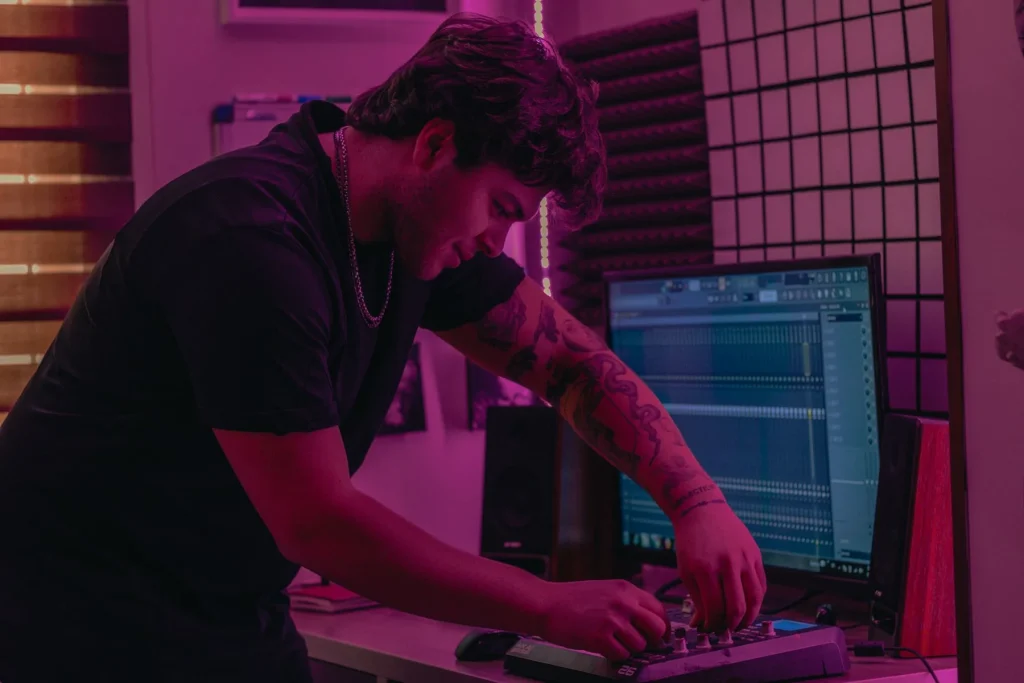
Computer-assisted music has a place in lessons as a tool for exploring sound, composing and presenting work as a group. It forms part of an active curriculum that values experimentation and hands-on practice.
Target skills: perceiving and listening analytically, producing with digital tools, and discussing and explaining artistic choices.
Tools, materials and scenarios for computer-assisted music
Common resources include music production software, portable recorders, sound libraries, MIDI interfaces and online teaching guides.
Adaptable example scenarios include a small arrangement project, creating a soundscape, an educational remix and a narrated audio piece.
Alignment with the curriculum comes through lesson objectives, assessment criteria and digital records of work. In class, organize short workshops followed by critical listening and a group presentation.
“Modular scenarios make practical work accessible regardless of students’ technical level.”
Teacher training should meet practical needs: learning to use software, managing groups and designing inclusive activities. These resources can be adapted to ensure accessibility and progress.
Looking at the curricula: civic education in high school and continuity from first grade to the final year
Throughout schooling, French moral and civic education balances requirements with teaching freedom to build a progressive path toward citizenship. The framework clearly distinguishes what must be taught from approaches that may be used.
Required concepts and content, optional approaches
Columns 1 and 2 present the required concepts and content. They define the knowledge and skills students must acquire.
Column 3 suggests flexible approaches. The learning situations are options, not requirements.
A spiral approach to concepts: freedom, democracy and secularism
Learning progresses through each stage from first grade to the final year of high school. Concepts such as freedom, democracy and secularism recur with increasing complexity.
Moral and civic education becomes a setting for guided debate. Its aim is to develop students’ critical thinking.
“Moral and civic education connects knowledge and practice to develop thoughtful citizens.”
| Column | Content | Function |
|---|---|---|
| 1 | Required concepts | Official framework, knowledge to teach |
| 2 | Required content | Skills to assess during the year |
| 3 | Possible approaches | Adaptable learning situations |
Tip: spread these approaches throughout the year. Choose realistic, transferable projects, including links with music, to make democratic values tangible.
Media literacy, sustainable development education and digital citizenship throughout learning pathways
Media literacy and sustainable development education are becoming themes that run throughout schooling rather than stand-alone modules. They are part of the annual curriculum and inform every teaching sequence.

Integrating cross-curricular education into annual themes
Within each theme, media education and sustainable development education are linked to the subject matter. The curriculum encourages teachers to treat these as learning objectives rather than separate sections.
Practical classroom activities beyond Press and Media Week
Music examples include critically analyzing audio sources, considering copyright and designing events with environmental impacts in mind. These activities help students understand practical issues.
Easy-to-implement activities include tracking music news through reliable sources, creating a mind map of digital risks and running fact-checking workshops. Use documented work as evidence for assessment.
“Teaching media literacy throughout the year strengthens critical thinking and online responsibility.”
Assess students by observing their practices, guiding self-assessment and reviewing the work they produce. Encourage collaboration with literature, history or science teachers to enrich learning.
Vocational education and CAP qualifications: distinctive features, study periods and workplace training
In vocational education, the same concepts from civic and music education are taught, but the structure emphasizes practical work and periods in the workplace. Workplace training periods are essential opportunities to apply knowledge and skills and transfer them to professional settings.
CAP course over one, two or three years: progressive learning and adaptation
The CAP course lasts one, two or three years, depending on the chosen pathway. Learning builds cumulative skills, with annual milestones and a logbook to record work in class and during workplace training.
Using joint teaching and the capstone project
Joint teaching between vocational subjects and music encourages practical projects. The capstone project provides a framework for creativity, critical thinking and civic skills.
“Connecting school, work and creative practice grounds learning in professional reality.”
| Element | Function | Frequency |
|---|---|---|
| Workplace training periods | Practical application of learning | Several periods each year |
| Course plan | Progress over one to three years | Annual monitoring |
| Joint teaching | Cross-curricular projects | At least one per year |
| Capstone project | Final assessment and presentation | Final project |
Teaching projects and schedules: from yearlong themes to one-off activities
Planning a music project begins with choosing its duration: a yearlong theme, a short module or a one-off activity.
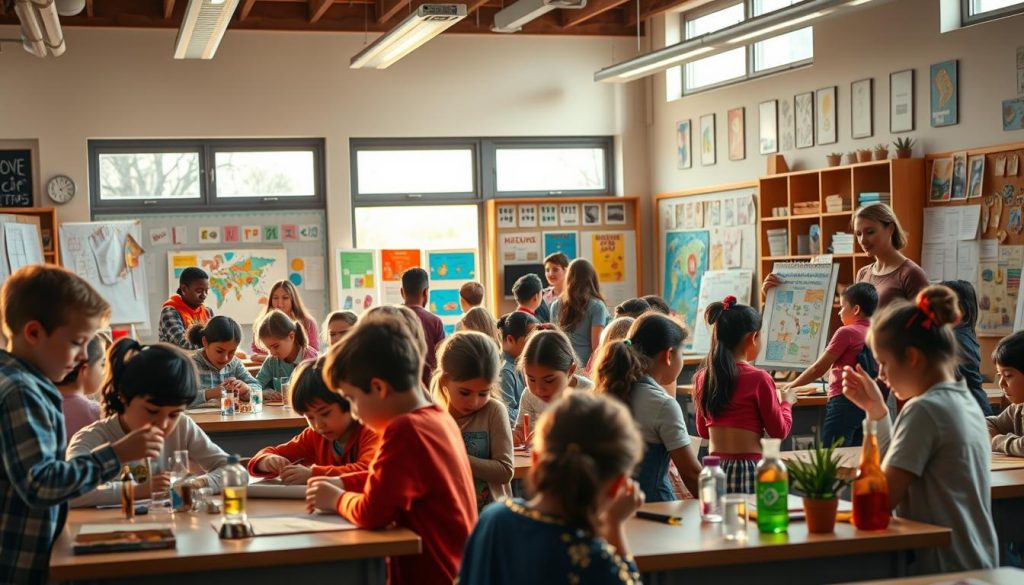
Designing realistic projects requires clear objectives aligned with the curriculum. Define deliverables, success criteria and a simple schedule.
Instructional planning: list resources, assign classroom roles, set milestones and plan regular formative assessments.
- Time frames: a yearlong theme, modules lasting a few weeks, or themed days.
- Transferability: design repeatable tasks so students become more independent.
- Documentation: audio and video portfolios and reports support assessment and progress tracking.
Include computer-assisted music through short productions linked to the curriculum. These one-off activities produce tangible, motivating results.
“A structured review at the end of an activity helps adjust the learning pathway and improve skills the following year.”
Developing civic and social-emotional skills through music
Music provides a practical setting for developing empathy and cooperation from the earliest school years.
Social-emotional skills can be developed through musical activities: cooperation, empathy, emotional regulation and communication.
Cooperation, empathy and attitudes in learning situations
Offer varied activities: choirs, instrumental ensembles, shared listening workshops or group compositions. These formats involve discussion and shared responsibility.
In class, arrange pairs, peer mentoring or assigned roles (group leader, sound recorder, reviewer). These methods strengthen independence and mutual support.
Empathy grows when students learn to describe a peer’s musical intention and give constructive feedback. Outside class, arrange performances and schoolwide projects that recognize students’ involvement.
“Working together on a piece teaches listening as much as technique.”
| Skill | Activity | Evidence |
|---|---|---|
| Cooperation | Instrumental ensemble | Guided observation |
| Empathy | Listening workshop | Peer feedback |
| Emotional regulation | Choir | Self-assessment |
Document progress through self-assessments, peer feedback and observations. This makes these skills part of students’ learning pathways and the school curriculum.
Assessing without overburdening students: knowledge, attitudes and abilities
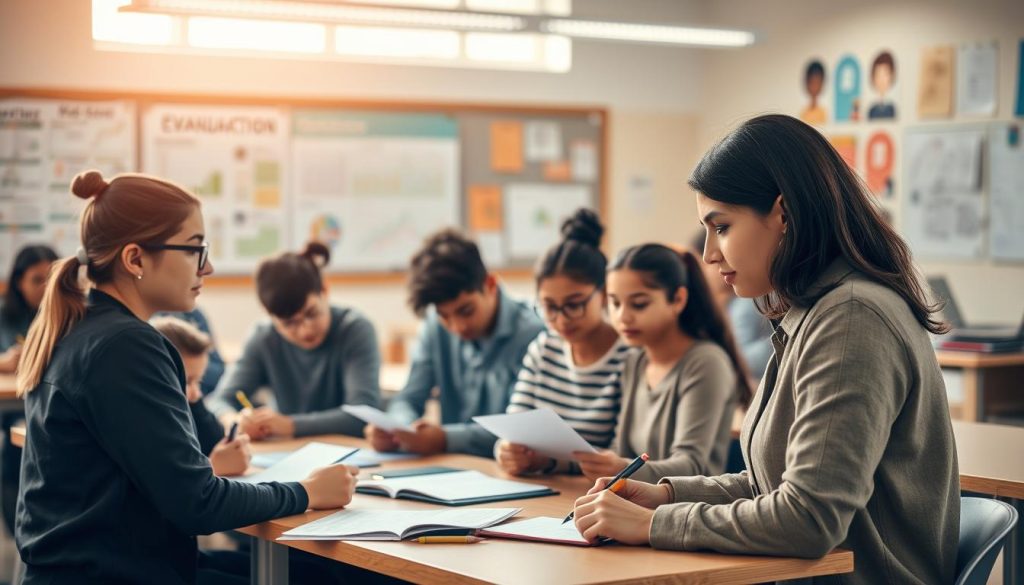
Avoiding constant assessment begins with defining a clear framework. Divide expectations into three areas: musical knowledge, values and attitudes, and technical abilities.
Assessment methods: criteria, timing and evidence
Choose focused, varied methods to limit the workload. Favor criteria-based rubrics, brief oral presentations and dated audio work.
Spread assessments throughout the year: a few periodic reviews and a balance between formative and summative assessment. Select essential criteria for each teaching sequence that align with the curriculum.
- Clarify what is being assessed: knowledge, cooperation and technical skills.
- Methods: guided observation, recording and short interview.
- Reduce the workload: limit the number of criteria for each assessment.
- Value self-assessment and peer assessment to encourage student responsibility.
“Simple, relevant records (portfolios, logbooks and recordings) are enough to track progress.”
Practical tip: keep dated digital records. They make it easier to track progress and communicate with families without adding more tests.
Citizenship education and interdisciplinary work: music, civic education and the arts
Combining music with moral and civic education supports coherent learning pathways from middle school through high school. This work takes place in class and through schoolwide projects.
Goal: build an active path toward citizenship based on the curriculum and practical activities.
Connections with the visual arts and other subjects
Combine music and visual arts to create sound and visual installations. Arrange guided exhibitions that involve analysis and presentation.
Extend these projects to literature, history and science to explore topics related to media literacy or sustainable development education. These connections strengthen students’ awareness and critical thinking.
- A multimedia exhibition on a citizenship theme.
- A civic podcast produced by classes.
- A group performance linked to the school calendar.
The school’s role: coordinate the team, schedule shared events and ensure alignment with the curriculum. This keeps students’ progress clear and coherent.
“Interdisciplinary work turns the learning pathway into a place for engagement and practical learning.”
Selections, favorites and content organization
Creating personalized lists helps you quickly find items useful in class. The selection feature lets you group resources and curriculum-related documents by theme.
Creating and managing items by section
Bookmark an item to find it later. Use the “item selections” option to organize each entry by section.
Quick actions: add this item to a lesson-planning folder or add it to a shared collection.
Access: some features require an account. To activate these tools, register or sign in as indicated by the interface. Some features may be restricted: they are intended for staff.
Organization tip: sort content by curriculum, grade level, year or resource type. Update your selections after each curriculum revision to keep your resource tracking current.
| Feature | Purpose | Access |
|---|---|---|
| Selections | Lists by section or theme | Public / account useful |
| Bookmark this item | Find it quickly later | Open access |
| Add this item | Lesson-planning folder | Account sometimes required |
| Feature intended for staff | Restricted areas | French national education staff |
Grade levels and educational stages: primary school, middle school and high school — continuity of learning
Music education is organized into stages that support the development of skills from first grade through the final year of high school.
Each stage sets progressively more demanding objectives. Curriculum benchmarks are adapted to students’ ages and teaching contexts.
Continuity across grade levels allows the same framework to be adapted to different levels. This supports transitions and reinforces what students have learned.
In vocational education, the CAP takes one, two or three years depending on the chosen pathway. This flexibility accommodates individual learning speeds and course requirements.
Coordination among primary schools, middle schools and high schools makes it easier to share resources and activities. Collaboration across levels encourages reusable, clearly structured lessons.
Assessment also follows a progressive approach. Distinct criteria for each stage support development and make objectives clear to students.
“Shared benchmarks and appropriate assessment support continuous progress from primary through secondary education.”
| Element | Function | Frequency |
|---|---|---|
| Educational stage | Structure progression | Continuously, year after year |
| Primary → middle school transition | Strengthen foundational learning | Transition review |
| CAP (one to three years) | Adapt the vocational pathway | According to the individual pathway |
Supporting resources for music curricula
Varied materials help teachers prepare, deliver and assess lessons that follow the curriculum. They bring together formats designed for classroom use and for developing students’ skills.
Documents, videos and implementation examples
Available formats:
- Worksheets focused on a lesson or objective.
- Videos of classroom practice and demonstrations.
- Teacher accounts and ready-to-use teaching scenarios.
Classroom use: draw on these materials to build a learning plan, prepare assessment criteria and document implementation.
The page also provides links to download the supplementary and prescribed curricula for 2024–2025. Training modules support self-directed study and continuing professional development.
Adapt each example to your school’s context. Check regularly for updates to keep your selection relevant.
Quick directory: useful links to curricula and supplements
Go directly to the official files, 2024–2025 supplements and relevant Official Bulletin references. This directory makes it easier to access downloadable texts and add them to your selections for teaching.
Download the curricula and consult the supplements
Recommended list:
- Download the curricula: a direct link to the official files for your planning.
- Special Official Bulletin No. 1 — January 22, 2019: main regulatory reference.
- Special Official Bulletin No. 8 — July 25, 2019: supplementary provisions and regulatory details.
- National supplementary curriculum (elective, final two years) — 2024–2025.
- Prescribed curriculum for the final-year specialist course — 2024–2025.
All documents are in French and comply with the French national education framework. Add these files to the resources you track and check for updates each year.
“Grouping these references in your selections simplifies preparation and helps ensure lessons comply with the requirements.”
| Item | Content | Purpose |
|---|---|---|
| Download the curricula | Annual official files | Planning, lessons |
| Special Official Bulletin No. 1 (January 22, 2019) | Regulatory framework | Required reference |
| Special Official Bulletin No. 8 (July 25, 2019) | Details and supplements | Compliance |
| 2024–2025 supplements | Supplementary and prescribed curricula | Choice of works, specialist course |
Conclusion
Conclusion
To conclude, remember the key points that make teaching plans and professional resource tracking easier.
This directory brings together useful texts and curricula: teaching hours (three hours for the elective, four or six for the specialist course), the 2019 Official Bulletins and the 2024–2025 supplements. The note “Updated: August 2025” indicates the latest available revision.
For teaching, connect perception with production, use projects of varied durations and choose activities that develop civic skills.
Include media literacy and sustainable development education, and use workplace training periods and CAP study stages where relevant to ground students’ learning in real contexts.
Update your selections, check the supplements each year and use these resources to support high-quality teaching that is clear in the classroom and across the French national education system.