
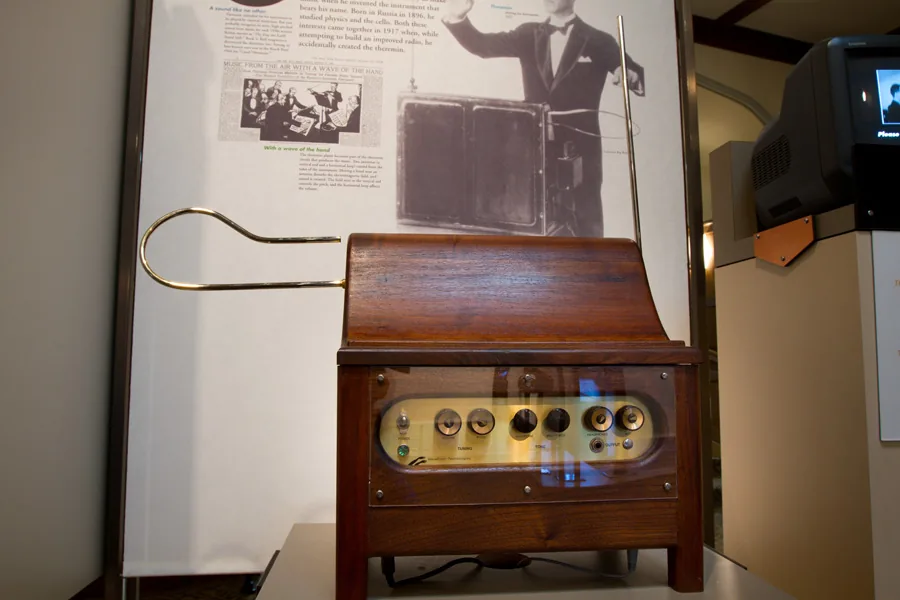
The theremin, one of the earliest electronic instruments, was created in 1920 by Leon Theremin, a Russian inventor. Its distinctive feature is that it produces sound without being touched. This marked a revolution in the history of music.
This instrument, which has only one note, uses electronic tubes. It has had a major impact on modern music. Many artists still draw inspiration from it today.
Introduction to the Theremin
The theremin is a musical instrument that is electronic and unique. It was invented in the early 20th century. It works without physical contact, using two antennas.
Musicians play it by moving their hands around the antennas. They change the frequency and volume to create notes. Thanks to Leon Theremin, this instrument opened the way to musical experimentation.
The theremin fascinates listeners with sounds that resemble the human voice. It can therefore suit different styles, including classical music and jazz.
It has influenced electronic music. Its potential has been explored in many compositions, demonstrating its impact on music.
To better understand the theremin, it helps to look at the history of electronic music. This history shows how early instruments evolved. The theremin demonstrates how technology and musical art can come together to produce innovations.
Origins and Creation of the Theremin
The theremin, a unique instrument, was created by Leon Theremin in 1920. At the time, the Russian Revolution of 1917 still had a profound effect on society. Leon Theremin, a talented physicist, brought innovative ideas to this period of political and social change.
The invention of the theremin was a technical advance, but it also reflected the artistic ambitions of the era.
Leon Theremin’s Journey as a Russian Inventor
Leon Theremin, born in 1896, had an unusual career. With a degree in physics, he devoted himself to musical research. He wanted to create an electronic instrument.
His invention of the theremin grew out of experiments with oscillator circuits. His creativity and ambition earned him recognition.
The Russian Revolution of 1917 and Its Influence on the Invention
The Russian Revolution played a crucial role in Leon Theremin’s career. The Bolshevik government, particularly Lenin, supported his work. The theremin was regarded as a symbol of modernity and innovation.
This historical influence opened new possibilities for Theremin. His instrument inspired other creators of the period.
| Year | Event | Context |
|---|---|---|
| 1919 | Presentation to Lenin | First demonstration of the theremin |
| 1920 | Invention of the theremin | Launch amid revolutionary change |
| 1927 | Official support | Promotion by the Bolshevik government |
History of the Theremin: The Instrument That Revolutionized Music
The theremin changed music. Lenin’s promotion made the instrument a symbol of creativity. This had a major impact on 20th-century music.
Lenin’s Promotion of the Instrument
Lenin ordered 600 theremins for the USSR. This initiative brought Leon Theremin international attention. His tours showed the potential of this iconic instrument.
Leon Theremin’s World Tours
Leon Theremin’s tours captivated audiences around the world. His theremin fascinated audiences in the United States. He performed with famous artists and left his mark on the music of his time.
| Year | Key event | Impact |
|---|---|---|
| 1919 | Invention of the theremin | Beginning of this iconic instrument’s history |
| 1920-1930 | Promotion by Lenin | Growing popularity in the USSR |
| 1930 | Leon Theremin’s American tour | Introduction of the instrument to America |
| 1950 | Use in cinema | Establishment of the theremin in popular culture |
Leon Theremin’s career left its mark on music history. Lenin’s promotion helped establish the theremin’s place in it. The instrument remains a source of inspiration for artists today.
How the Instrument Works
The theremin is a musical instrument that is electronic and unique. It uses a heterodyne oscillator to create sounds. This system lets musicians play by moving their hands around the antennas.
Pitch depends on the distance between the hand and the vertical antenna. The closer the hand, the higher the note. The horizontal antenna controls volume. Performers can therefore play without touching the instrument.
To learn more about the theremin, visit The Theremin Fugue. You will discover the story of Leon Theremin and his invention. The theremin is still used in electronic music today.
| Aspect | Description |
|---|---|
| Instrument type | Contactless electronic instrument |
| Operating principle | Heterodyne oscillator |
| Pitch control | Distance from the vertical antenna |
| Volume control | Position relative to the horizontal antenna |
| Musical experience | Creating fluid sounds through gestures |
Oscillators changed electronic music. They opened the way to new sonic ideas. New technologies are changing how we experiment with music.
The Theremin’s Impact on Electronic Music
The theremin has greatly influenced electronic music. It uses electromagnetic fields to create distinctive sounds. This opened new possibilities for composers.
The theremin introduced sounds that had not been heard before and created a distinctive atmosphere. It inspired many artists. Its use transformed music production and encouraged the invention of other electronic instruments.
Its Role in the Development of Contemporary Music
The theremin has been used in films such as “The Day the Earth Stood Still”. It left its mark on popular culture. The instrument became a symbol of science-fiction music.
It influenced how electronic sounds were perceived in cinema. The sounds of the theremin made it possible to explore new emotions. This strengthened its importance in modern electronic music.
Iconic Uses in Cinema and Popular Culture
The theremin has appeared in celebrated works beyond cinema. Artists such as Aphex Twin have reinterpreted it in their work. It continues to inspire producers and connects electronic music’s past with its future.
In conclusion, the theremin pioneered new sounds. It plays an essential role in today’s musical trends.