
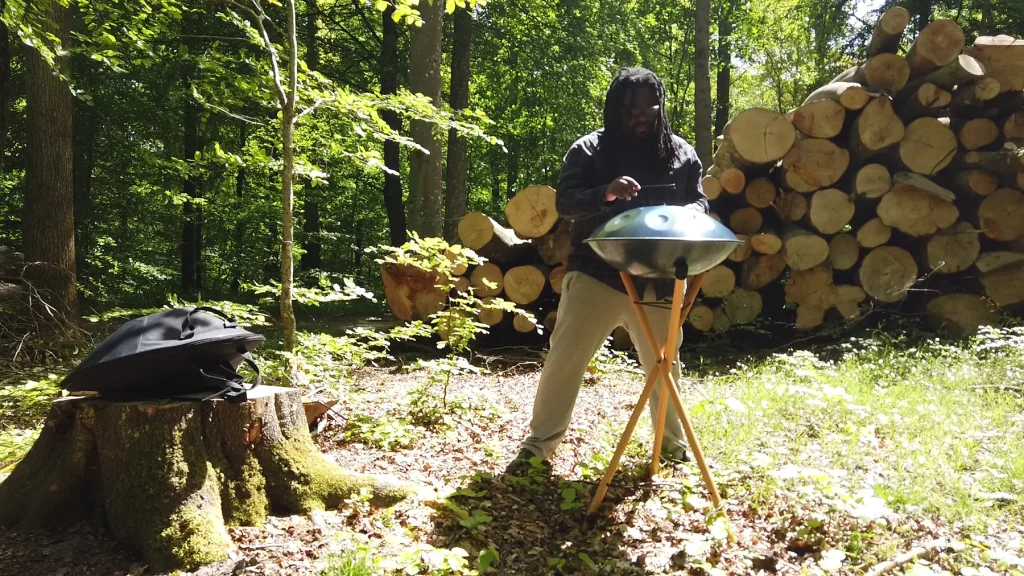
In this 2025 guide, we help you make an informed choice when introducing a young musician to music. The handpan is a captivating melodic instrument for children. Its distinctive design and harmonious notes make learning intuitive.
We will cover essential criteria such as ergonomics, including an ideal weight of 1.5 to 2 kg and a diameter of 25 to 30 cm. These dimensions let small hands play without tiring.
The recommended number of notes for a beginner is 11 to 12. This offers a good balance between simplicity and musical range. C major is also a sensible choice, as it covers 78% of nursery rhymes.
Brands such as Kudout, Moozica and Sonodrum offer suitable models made from durable materials and fitted with rounded edges for greater safety. Depending on the retailer, these instruments cost between €59 and €200.
1. Why choose a handpan for a child? Benefits and appeal
Small melodic percussion instruments offer much more than entertainment. They provide tangible benefits for young musicians’ development. As children play, they discover a world of sound that stimulates their curiosity and creativity.
Regular practice on this instrument improves hand-eye coordination by 37%. This strengthens motor and cognitive skills. Children also learn to listen actively, which supports their overall learning.
Here are some key benefits:
- Better memory: Playing music can improve children’s memory by up to 30%.
- Greater concentration: Reproducing melodies strengthens active listening and concentration.
- Social skills development: Playing in a group teaches children to listen and adapt.
- A foundation for further learning: The instrument prepares children to play more complex instruments.
- Emotional expression: Music provides a creative outlet that builds self-confidence.
The handpan’s warm sounds also encourage relaxation. Children can produce beautiful notes within minutes, giving them an early sense of achievement. This ease of playing builds their confidence.
1.1. Educational and developmental benefits
The handpan supports psychomotor development. Playing with the fingers or mallets strengthens dexterity and precision. Children learn through play and can improvise freely.
1.2. Effects on motor skills, memory and creativity
Playing melodies stimulates concentration and helps children remember sequences. They learn to recognize melodic patterns, an important part of intellectual development. Through improvisation, they turn emotions into sounds and strengthen their creativity.
1.3. Safety and use in French schools
Models intended for young players meet CE standards. Their rounded edges and one-piece construction help ensure safety. In France, use of this instrument in schools has increased by 45%, reflecting its educational value.
In schools, some instruments remain usable after five years, demonstrating their durability. Their use in music therapy also shows a positive effect on children’s well-being.
2. Introducing instruments for children: handpans and related instruments
Let’s explore musical instruments for younger players. The handpan is a fascinating instrument that has grown in popularity. Its construction and sound distinguish it from other instruments. Made from two steel shells, it produces harmonious notes that captivate listeners.
2.1. What is a handpan? Origins and how it works
The handpan is a melodic percussion instrument that developed from the Hang® in the early 2000s. Unlike a traditional drum, it is played with the hands rather than sticks. Each note is carefully tuned to produce rich overtones, giving it a distinctive sound.
The notes are arranged in a circle around a central note called the Ding. The lower shell has an opening called the Gu, which contributes to its resonance. This design makes it possible to play soothing, engaging melodies.
2.2. Comparing the tongue drum with other melodic percussion instruments
The tongue drum is another popular instrument. It uses tongues cut into steel and is much lighter, weighing around 1.8 kg. This makes it easy to carry and play. Beginners can learn to play melodies in just 10 minutes.
By contrast, the handpan weighs around 5 kg and takes longer to master. It is therefore better suited to children aged 8 and over. The tongue drum has a more direct sound, while the handpan offers longer resonance and a richer tone.
Here is a comparison of the two instruments:
| Feature | Handpan | Tongue drum |
|---|---|---|
| Weight | About 5 kg | About 1.8 kg |
| Learning time | Several weeks | About 10 minutes |
| Sound | Rich and sustained | Direct and clear |
| Recommended age | From age 8 | From age 3 |
Other percussion instruments, such as the kalimba and xylophone, are also excellent for developing a young person’s musical sensitivity. Each instrument has its own qualities. Starting with a tongue drum can help children learn the basics before moving on to a handpan.
3. At what age should a child start playing the handpan? Motor and cognitive considerations
Introducing a young musician to an instrument can seem challenging, but a few criteria make the process easier. Consider motor skills, attention and coordination before beginning lessons.
3.1. Skills needed to play
To play well, a child needs to develop certain skills. First, they must be able to strike with the fingertips using a light rebound. This requires coordination between both hands, which is essential for playing melodies.
Attention is equally important. The child needs to concentrate for a few minutes, listen to a note resonate and produce the next sound at the right moment. These abilities indicate a level of maturity that makes learning easier.
A gentle touch is also essential. Unlike conventional percussion, this instrument calls for delicate movements that reveal each note’s tone and resonance.
3.2. Age groups and learning recommendations
From age 3 or 4, children can explore very light versions of the instrument through play. Ages 6 to 8 are ideal for more structured learning. Three factors matter most: the ability to concentrate, a gentle touch and the desire to try again.
During a workshop, one usually noisy pupil learned to play in less than ten minutes. The instrument’s lingering sound prompted her to listen before acting.
For children under 4, choose playful exploration with ultralight instruments weighing less than 1 kg. For ages 4 to 6, gradual learning on an instrument with 11 to 13 notes in C major is recommended. Short sessions of 10 to 15 minutes will help maintain their motivation.
| Recommended age | Type of instrument | Learning approach |
|---|---|---|
| 3 to 4 years | Lightweight instruments | Playful exploration |
| 4 to 6 years | Instruments with 11 to 13 notes | Gradual learning |
| 6 to 8 years | Handpan | Structured learning |

4. Models for children: handpan or tongue drum?
Exploring instruments suited to young musicians is important for their musical development. Choosing between a handpan and a tongue drum can shape their learning experience. Each has features that meet different needs.
4.1. Differences in weight, size, handling and maintenance
Start with weight. A tongue drum weighs around 1.8 kg, so a child can handle one easily from age 3. A handpan, by contrast, often weighs around 5 kg and requires more strength and coordination.
In terms of size, a tongue drum’s cut-out tongues provide an intuitive playing surface. A handpan, with a diameter of 45 to 55 cm, requires a suitable posture to reach every note.
As for maintenance, a tongue drum stays in tune without retuning. A handpan may need annual attention from an instrument maker, with professional retuning costing around €150.
4.2. When and why to move from a tongue drum to a handpan
Beginners can play melodies on a tongue drum in about 10 minutes. Learning to strike a handpan properly and coordinate both hands takes several weeks.
Starting with a tongue drum at home or school is recommended. It helps children develop a sense of rhythm, confidence and enjoyment of playing. Once a child can coordinate their hands and wants to explore richer tones, they can consider moving to a handpan.
Signs that a child is ready include good coordination between both hands, the ability to repeat steady patterns and a desire to explore a wider repertoire.
For beginners seeking suitable tongue drums, recommended models include the Kudout Mini (1.2 kg, 28 cm), Moozica Junior (1.4 kg, 30 cm) and Sonodrum Light (1.1 kg, 25 cm).
5. Essential criteria for choosing a handpan for a child: notes, key and scale
Several criteria matter when choosing a musical instrument. The number of notes, its key and the type of scale all contribute to a rewarding learning experience.
5.1. Recommended number of notes for a beginner
For a young musician, an instrument with 11 to 12 notes is ideal. It allows them to play around 92% of popular nursery rhymes while leaving room to improvise. An instrument with only 8 notes can quickly limit their repertoire, slow progress and discourage them.
5.2. Why choose C major
The key of C major is particularly recommended. It covers 78% of traditional nursery rhymes and makes tutorials, which are often written in C, easier to follow. Choosing this key avoids the need to transpose notes, simplifying learning at home and in groups.
For example, the nursery rhyme “Frère Jacques” can be played in full in C major on an instrument with 11 to 12 notes. It shows why this key is useful for young musicians.
5.3. Diatonic and pentatonic scales: benefits and limitations
A diatonic scale is ideal for teaching nursery rhymes and reading simple sheet music. A pentatonic scale encourages free improvisation and a calming playing experience. It almost eliminates the risk of clashing notes, building young musicians’ confidence.
However, a pentatonic scale can prevent children from playing some familiar melodies that require semitones. Avoiding more unusual scales before age 10 is therefore recommended to help sustain motivation. As the child progresses, a gradual move from a pentatonic scale to a diatonic C major scale can be beneficial.
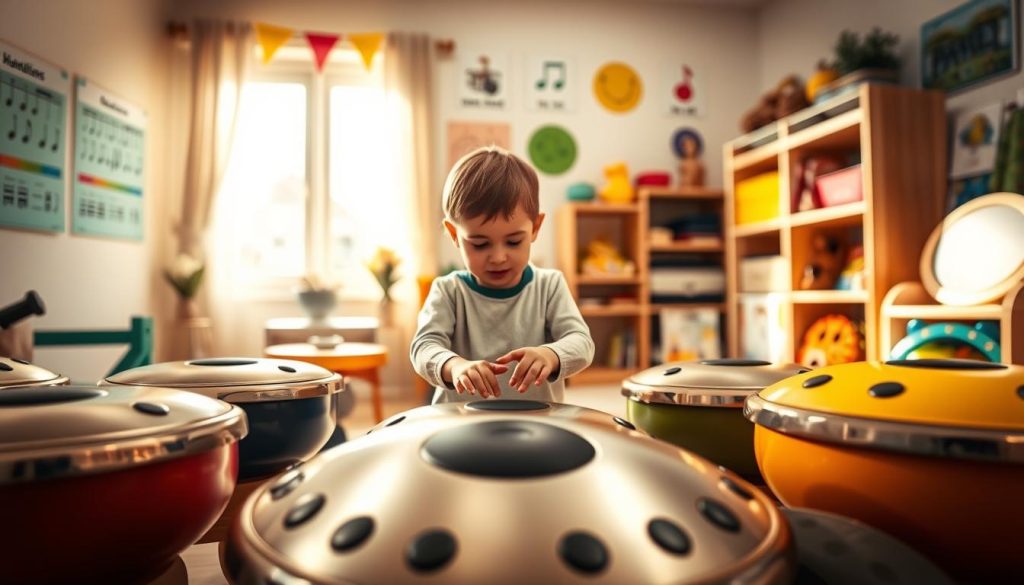
6. Ergonomics: choosing the right size, diameter and weight for each age
Good ergonomics can improve a young musician’s learning experience. Choosing the right size, diameter and weight is crucial for comfort and motivation.
6.1. Dimensions suited to children’s hands
For children under 6, choose an instrument weighing no more than 1.5 kg and measuring no more than 30 cm in diameter. One suggested rule is to allow around 1 cm of diameter for each year of age. For example, a 5-year-old would play an instrument measuring 25 cm.
For ages 6 to 9, favor a diameter of 25 to 30 cm, taking the child’s build into account. Avoid adult-size instruments before age 10.
6.2. Popular models and age-group guidelines
Here are a few suitable ergonomic models:
- Kudout Mini: 1.2 kg, 28 cm
- Moozica Junior: 1.4 kg, 30 cm
- Sonodrum Light: 1.1 kg, 25 cm
These instruments are designed to be comfortable for young musicians to handle.
6.3. How poor ergonomics can affect playing and health
An unsuitable instrument can cause muscle fatigue and pain in the wrists and shoulders. This increases the risk of musculoskeletal disorders in young players. Make sure the playing height and angle allow the wrists to move naturally.
Playing while seated, with the instrument on the lap or a stable stand, helps protect the joints. Trying an instrument in a shop, such as Cultura, can also help you check comfort and whether the notes are within easy reach.
Finally, avoid buying an instrument that is too large “for later.” A poor fit may discourage a child from continuing to play.

7. Materials and durability: stainless steel or nitrided steel
The materials used to make an instrument directly affect its performance and lifespan. Stainless steel and nitrided steel are among the most common choices. Each has distinct properties worth considering.
7.1. Comparing properties and durability
Stainless steel has an average lifespan of around 15 years. Its corrosion resistance is 63% higher, making it suitable for young musicians who may play with damp hands. Nitrided steel is lighter and produces warmer overtones, but remains sensitive to moisture. Its usable lifespan is around 8 years under demanding conditions.
7.2. Sound quality and resonance
The material determines the character of the sound. Stainless steel offers a full tone with generous sustain, suited to meditative music. Nitrided steel produces a more precise attack, ideal for percussive playing.
7.3. Care tips for each material
Regular care helps preserve sound quality and extend the instrument’s life. For stainless steel, apply Phoenix oil once a month after weekly cleaning with a dry microfiber cloth. For nitrided steel, use beeswax and wipe the instrument after every session. Avoid aluminum alloys, which can go out of tune quickly and rust easily.
For family use, stainless steel is often the best choice. It withstands moisture from hands better and needs less daily care while retaining its sound quality. Nitrided steel may suit specific needs, but requires more careful maintenance.

8. Practical recommendations by age: from exploration to regular playing
Choosing the right instrument helps give a young musician a positive learning experience. Here are age-based recommendations to encourage musical discovery and progress.
8.1. Under age 4: playful exploration
For toddlers, the main goal is to spark curiosity and give them immediate enjoyment. Choose an ultralight instrument weighing no more than 1 kg with 6 to 8 notes to explore through play. This allows discovery without frustration.
The YUEHAO Mini, with 11 notes and a weight of just 1 kg, is an example. Its compact format suits a safe first introduction to music.
8.2. Ages 4 to 6: gradual learning
At this age, learning can become more structured. Choose an instrument with 11 to 13 notes in C major so children can play nursery rhymes easily. Ergonomic mallets and an accessory kit can also enrich the experience.
The CAHAYA 12″ model has 13 tones and comes with a complete kit. It offers more melodic possibilities while remaining approachable at this stage of learning.
8.3. Over age 6: expanding the repertoire
For children over 6, the goal is to expand their repertoire and develop technique. An instrument with 13 to 15 notes is recommended for playing complete scales and practicing coordination.
The MeloBeat 15-note model is designed for young musicians ready for technical challenges. Its wider range of sounds supports a varied repertoire.
Keep sessions short, around 10 to 20 minutes depending on age. Regular practice supports steady progress. Avoid untuned toys, as they may distort a child’s sense of pitch and hinder long-term listening development.
9. Budget and where to buy a handpan for a child in France
Buying a musical instrument for a young musician means considering your budget and the available options. Prices vary considerably with the instrument’s quality and features. Here is an overview of price ranges.
9.1. Indicative prices for each range
A first good-quality instrument starts at around €59 for a 10-inch tongue drum. Premium beginner models can cost around €200. More versatile instruments can cost up to €350, particularly complete packages with cases and tuning services.
9.2. Reliable physical shops and online retailers
For your purchase, several retailers stand out in France. Cultura, Woodbrass and Thomann are established options. These shops offer advice, warranties and opportunities to try instruments before buying.
9.3. How to avoid counterfeits and check quality
Before making your choice, check a few things to avoid counterfeits. Make sure the instrument resonates for at least 8 seconds, stays in tune and comes with certificates confirming its materials are non-toxic. Read recent customer reviews to assess the quality of the model you choose.
Bear in mind that around 23% of imported products do not meet quality standards. It is therefore preferable to buy from authorized retailers that offer a tuning warranty and after-sales service.
10. Useful accessories for beginners and instrument protection
Suitable accessories can make learning easier. They improve the playing experience while protecting the instrument.
10.1. Ergonomic mallets and colored markers
Mallets are essential for playing. Choose models no longer than 15 cm to suit small hands. They allow precise playing without fatigue.
Cork tips produce a soft sound, while felt tips give a more pronounced attack. These options vary the volume and tone, enriching the musical experience.
Colored markers on the notes also make them easier to remember. They create a direct link between the sheet music and the instrument, reducing learning time by around 40%.
10.2. Covers, anti-vibration pads and temperature-regulating cases
A cover with an IP54 protection rating and at least 2 cm of padding is essential. It protects the instrument from impacts, dust and moisture during transport.
Temperature-regulating cases also help preserve stable tuning by limiting the effects of temperature and humidity changes. They are especially useful for instruments sensitive to moisture.
Anti-vibration pads stabilize the instrument during play. They prevent it from slipping on smooth surfaces and protect furniture from scratches while improving comfort.
10.3. How accessories affect motivation and longevity
Investing in quality accessories improves the musical experience. A small investment provides lasting protection for the instrument and encourages children to keep playing.
When used from the outset, these accessories strengthen a child’s motivation and speed up their progress. They also reduce future maintenance needs and make playing more enjoyable.
“A small investment in accessories protects the instrument and encourages the desire to play.”
11. Simple, motivating ways to introduce children to playing
Introducing a young musician to an instrument calls for a simple, visual approach suited to their age. A structured program can make learning enjoyable and rewarding.
11.1. A 30-day learning program
We suggest a 30-day program to guide young musicians. Days 1 to 7 are devoted to exploring sounds freely. Children can become familiar with the instrument without pressure.
Days 8 to 15 focus on simple rhythms. Children learn patterns that build their confidence. Then, from day 16 to day 25, guided songs such as “Frère Jacques” and “Au clair de la lune” help develop memory and coordination.
Finally, during days 26 to 30, children prepare a short concert to celebrate their progress and share the enjoyment of playing.
11.2. Learning resources: videos, color-coded sheet music and workshops
Several learning resources can enrich the experience. The “Tongue Drum Kids” video series and other short YouTube tutorials lasting 1 to 3 minutes are suitable. In fact, 78% of these tutorials are in C major, simplifying practice at home.
Color-coded sheet music, such as the “50 Comptines” method (2023 edition), uses a color system that speeds up learning by around 40%. Colored stickers on the notes help children connect the sheet music with the instrument.
Taking part in group workshops or using Montessori methods encourages children to interact. This develops mutual listening and group playing, making learning even more rewarding.
11.3. Encouraging regular practice and enjoyment
Consistency matters. Even 10 to 15 minutes of daily practice can turn curiosity into visible progress. Alternate structured learning with periods of free improvisation.
Value listening and creativity more than technical performance. This helps preserve the enjoyment of playing. Give children time to explore sounds and express themselves freely.
“Regular practice, even for 10 to 15 minutes a day, turns curiosity into visible progress.”
12. Conclusion
Choosing an instrument for a young musician calls for care. Favor C major and an instrument with 11 to 12 notes to play most nursery rhymes. This will make learning easier and encourage enjoyment.
Choose a weight and diameter suited to the child’s age. Look for quality materials such as stainless steel, which offers durability and a pleasing sound. Consider useful accessories too, including ergonomic mallets and a protective cover.
Ideally, start with a tongue drum to spark musical interest, then consider moving to a more complex instrument. Regular practice, even in short 10 to 15 minute sessions, will support a child’s creativity and confidence.
For more advice on choosing a suitable instrument, see our complete guide.