
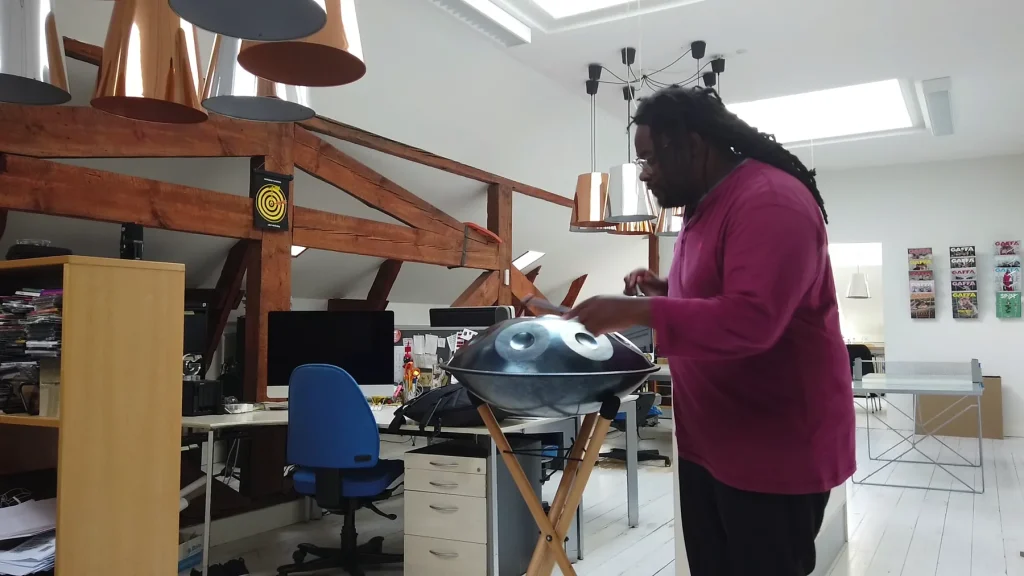
The handpan is a fascinating instrument that has captivated the music world in just 25 years. Its enchanting, mysterious sound sets it apart from other percussion instruments. This article takes you on a journey through its history, from the Swiss workshops where it began to the international stages where it is celebrated today.
We will explore its inventors, where it was created, and how its name and design evolved. We will also look at the important role this instrument plays in relaxing music and contemporary music therapy.
Although relatively new, the handpan already has a rich, documented history shaped by influences from several cultures. Get ready to discover the many facets of this unique instrument.
Introduction to the handpan: an instrument between tradition and modernity
The handpan, a fascinating instrument, draws on longstanding musical traditions to create a unique identity. Its story illustrates a fusion of older traditions and modern innovation. By exploring its influences, we can see how the Indian ghatam and the Caribbean steel drum helped shape this remarkable instrument.
Musical influences: from the Indian ghatam to the Caribbean steel drum
The ghatam, a terracotta pot, has been used in traditional Indian music for centuries. Measuring between 50 and 60 centimeters in diameter, it is struck with the hands to produce complex rhythms. This percussion instrument has long provided rhythmic accompaniment and influenced the handpan’s design.
The steel drum, which emerged in Trinidad and Tobago in the early 20th century, is another direct predecessor. Also known as the steelpan, this steel instrument is hammered to produce different notes. People in Trinidad and Tobago turned oil barrels into musical instruments in response to restrictions on traditional instruments.
- The ghatam produces captivating rhythms through its distinctive design.
- The steel drum produces gentle, melodic sounds central to Caribbean music.
- The similarities between the steelpan and the handpan are striking: a convex shape and notes tuned by hammering.
- The handpan combines the steel drum’s harmonic richness with the ghatam’s ease of playing.
The handpan: a unique percussion instrument with enchanting sounds
This melodic percussion instrument produces hypnotic vibrations that captivate listeners from the first note. Its range of notes makes it possible to create soothing soundscapes without knowing how to read music. That accessibility has helped it grow in popularity throughout the music world.
Blending tradition and modernity, the handpan’s enchanting sounds make it a favorite among musicians. It captures the grace of music: every note resonates with emotional depth. As one musician put it:
“The handpan opens a door to a world of vibrations and melodies.”
Origin of the handpan: the history and invention of this instrument
The birth of this unique musical instrument grew out of a remarkable collaboration between creative minds. Felix Rohner and Sabina Schärer, founders of PANArt, played decisive roles in its development. Their meeting with percussionist Reto Weber was another turning point.
The creators: Felix Rohner, Sabina Schärer and Reto Weber
Felix Rohner, a former teacher, discovered the steel drum in 1976. The encounter sparked his passion for making instruments. In 1993, he founded PANArt Steelpan Manufaktur SA with several partners. Sabina Schärer, his partner, joined the team in 1995. Together, they developed technical innovations that shaped the instrument’s sound and structure.
A key moment came in November 1999, when percussionist Reto Weber visited Rohner and Schärer. He had come to have his steel drum tuned, but he also suggested making a metal ghatam that would be lighter and stronger. His suggestion inspired the creation of an entirely new kind of instrument.
- Felix Rohner: A former teacher who became a steelpan maker, he pioneered the manufacture of steel instruments.
- Sabina Schärer: Rohner’s collaborator, she joined PANArt in 1995 and played an essential role in its technical development.
- Reto Weber: His visit proved decisive; he proposed a new approach inspired by the ghatam.
Where and when it was created: Bern, Switzerland, in the late 1990s
PANArt’s workshops in Bern, Switzerland, were the birthplace of this musical invention. There, Rohner and Schärer worked intensively in the late 1990s, carrying out extensive research and testing prototypes.
The final form, made of two convex shells, drew inspiration from instruments including the tabla and gamelan. The first Hang was completed in 2000 and presented at the Musikmesse trade fair in Frankfurt in 2001. That presentation introduced the instrument to an international audience.
The creators’ journey from concept to finished instrument shows the passion and innovation behind this remarkable instrument. To learn more about how it developed, read our article.
From Hang to handpan: how the design and name evolved
This musical instrument has undergone significant changes. The term “Hang,” meaning both “hand” and “hill” in the Bernese dialect, was used for the earliest generations. Made between 2000 and 2005, these models were offered in as many as 45 different scales and captivated musicians around the world.
By 2002, more than 1,000 had been sold, mainly by post from Switzerland. This success raised the company’s profile, and it changed its name to PANArt Hangbau SA in 2003.
The instrument’s popularity surged in 2005 and 2006 as videos spread widely on YouTube. Demand soon far exceeded supply. In response, PANArt ended its relationships with retailers and even required prospective buyers to submit handwritten letters explaining why they wanted one.
In 2007, Kyle Cox proposed the term “handpan.” It combines “hand” with “pan,” a reference to the steelpan of Trinidad and Tobago. The new name came to describe the instruments modeled on the Hang that appeared later.
- Etymology: The word “Hang” reflects the instrument’s domed shape.
- Early generations: Between 2000 and 2005, 45 scales were available.
- Commercial success: More than 1,000 had been sold by 2002.
- Surging popularity: The rise of YouTube videos increased demand.
- PANArt’s decision: It ended its retailer agreements to protect quality.
- New versions: The Caisa, Bells and Halo helped bring this type of instrument to more people.
These new versions broadened the market and gave more musicians access to this fascinating instrument. The shift from “Hang” to “handpan” marked an important turning point in its history.
Handpan making: materials and sound
Making this instrument is a fascinating, complex process. The materials and production methods are crucial to its sound quality. At the heart of its design is Pang, a nitrided steel alloy developed by PANArt. Enriching the steel with nitrogen improves its mechanical properties and resistance to corrosion.
Pang: nitrided steel and technical innovation
Pang was developed beginning in 1994. This material helps produce a rich sound that lasts. Its nitrided surface also contributes to the instrument’s longevity, an important consideration for musicians investing in a quality instrument.
Tuning and acoustic design
Tuning is an art in itself. Skilled makers hammer each note with great precision. This creates a 1:2:3 harmonic relationship that underpins the instrument’s rich sound. The relationship comprises the fundamental, the octave and the octave-plus-fifth, producing an enchanting harmony.
Structure and shape: two convex shells and tuned notes
A traditional handpan consists of two joined convex shells. The upper shell holds the notes, often arranged in a circle around a central note called the “ding.” This layout lets the sounds resonate together.
A tuned opening in the lower shell produces a Helmholtz effect that further enriches the timbre. “Shoulder tones” around the edges of the note fields add frequencies and give the sound greater depth.
Each handpan is designed around a single scale, making it easier to avoid clashing notes. Musicians can improvise freely and enjoy an intuitive, liberating musical experience.
| Feature | Details |
|---|---|
| Material | Nitrided steel alloy (Pang) |
| Tuning process | Hand hammering by skilled makers |
| Structure | Two convex shells |
| Notes | 8 notes around the “ding” |
| Acoustic effect | Helmholtz effect and shoulder tones |
| Scale | One scale per instrument |
PANArt’s production halt and its effects on the market
In 2013, PANArt surprised many in the music world by stopping production of the Hang. The company wanted to focus on innovative new projects. These included instruments such as the Gubal, Gudu, HangBal and Pang strings, which have distinct sounds even where they look similar.
The halt opened the way for substantial growth in the number of independent makers. Today, more than 400 craftspeople worldwide make handpans, offering a range of models and quality levels. Prices also vary widely, with entry-level instruments selling for between €1,000 and €1,500.
The effects on the market have been significant. Greater supply has pushed prices down and made the instruments more accessible. This wider availability has also been accompanied by legal tensions. In 2020, PANArt began taking steps to assert its intellectual property rights, seeking to prevent other makers from producing handpans.
Another turning point came on July 1, 2024, when PANArt announced that it was resuming Hang production. The decision may be connected to the ongoing legal dispute. The market’s future nevertheless remains uncertain while legal questions are unresolved.
The situation is paradoxical: PANArt’s production halt helped the instrument spread widely, while also creating tensions with its creators. Anyone looking to buy a handpan faces a complex market in which quality and prices vary considerably.
- Hang production stopped in 2013 as PANArt pursued new projects.
- New instruments developed: Gubal, Gudu, HangBal and Pang strings.
- Substantial growth in independent making: more than 400 craftspeople worldwide.
- Market effect: greater supply and lower prices.
- PANArt began legal action in 2020 to protect its rights.
- The resumption of Hang production was announced on July 1, 2024.
- Legal questions leave the market’s future uncertain.
- Wider access to the instrument has coincided with tensions involving its creators.
| Event | Date | Consequence |
|---|---|---|
| Hang production stopped | 2013 | Focus shifted to new projects |
| New instruments developed | 2013–2014 | Gubal, Gudu and HangBal introduced |
| Rapid growth in independent making | After 2013 | More than 400 craftspeople worldwide |
| PANArt began legal action | 2020 | Protection of manufacturing rights |
| Hang production resumed | July 1, 2024 | Return to the market |

The handpan’s wider appeal: popularity and uses today
Over the years, this instrument has risen rapidly to become a worldwide phenomenon. Its popularity owes much to its soothing sounds and accessibility. Today, it appears in a variety of musical and therapeutic settings.
Social media and video platforms have played a key role in its spread. Videos of musicians playing have generated considerable enthusiasm. On YouTube, for example, people share demonstrations and tutorials, helping more people discover the instrument.
Worldwide enthusiasm through social media and video platforms
Performance videos have brought the handpan into the spotlight. Players share their music and attract new enthusiasts. This has allowed thousands of people to explore the instrument’s distinctive sounds.
Uses in music therapy, meditation and musical performances
The handpan also has a place in therapeutic settings. It is used in music therapy for its relaxing effects. Its soothing vibrations can help reduce stress and support meditation. It is also heard in yoga sessions, accompanying breathing and creating a relaxing atmosphere.
Street musicians and professional orchestras alike include this instrument in their performances. Its clear notes add a distinctive melodic texture to their compositions.
Accessibility and self-directed learning
As online tutorials have grown, many people have been able to teach themselves. Anyone can now get acquainted with the handpan without a teacher. This has helped build a growing community of musicians who share their compositions and techniques on video platforms.
Handpan buyers range from beginners to professional musicians. All are drawn to the ease of playing and rich sound of this instrument. Its growing availability in specialist shops and online also makes it easier to acquire.
Within a decade, the handpan went from a little-known instrument to a global cultural phenomenon. Its wider reach has changed how people engage with music and made the instrument accessible to more people.

Names and classifications: handpan, Hang drum, pantam and more
The different names for these instruments reflect their variety and evolution. Several terms in the music world refer to similar instruments, which can be confusing. The most common include handpan, Hang drum, pantam and UFO Drum.
Differences and similarities between the names
The term “pantam” combines steel pan and ghatam. It was first used by an Israeli PANArt distributor and later popularized by Victor Levinson in 2014. Each name has its own associations, but all refer to similar percussion instruments.
- Hang: PANArt’s trademark for a specific instrument.
- Handpan: A generic term for similar instruments.
- Pantam: A combination of pan and ghatam, introduced by Levinson.
- Hang Drum: A common name, though technically inaccurate.
- UFO Drum: A reference to the flying-saucer shape.
Instrument classification: idiophone and percussion
In instrument classification, the handpan is a percussion idiophone. Unlike a drum with a membrane, it produces sound through the vibration of the metal itself. This distinction helps explain the instrument’s sound.
How names influence perception and popularity
Names strongly influence public perception. For example, “Hang Drum” remains a widely searched term on Google even though it is technically inaccurate. Its popularity can create mistaken expectations about an instrument’s quality and features.
The handpan’s distinctive flying-saucer shape has also encouraged the everyday use of “UFO Drum.” For makers of quality handpans, clear and consistent terminology helps distinguish their instruments.
The many names reflect how young this instrument is and how it continues to evolve in the music world. As the handpan becomes more popular, new names may emerge.
Conclusion
The handpan’s journey tells a story of innovation and passion. From Reto Weber’s idea to the instrument Felix Rohner and Sabina Schärer created in PANArt’s workshops, this instrument has captivated the world. The shift from “Hang” to “handpan” was an important step in its recognition.
Technical innovations such as Pang nitrided steel and the careful hand-tuning process have produced exceptional sound quality. Today, more than 400 makers contribute to a diverse range of models, giving a broad audience access to this instrument.
Its rapid spread through social media and self-directed learning has helped establish the handpan in musical and therapeutic practice. With PANArt announcing the Hang’s return in 2024, this instrument appears set to keep evolving.
For anyone still deciding, a comparison guide to the handpan and tongue drum can help them find the instrument that suits them.