

The handpan is a fascinating musical instrument that draws attention with its distinctive shape and enchanting sounds. Played mainly with the hands, it requires no knowledge of music theory. This instrument was invented in Switzerland in 2000 by PANArt, a company founded by Felix Rohner and Sabina Schärer.
In this article, we will explore how this unique instrument works, its notes and its distinctive features. We will cover its origins, physical characteristics and acoustics. We will also offer a practical guide for anyone who wants to learn to play it.
The handpan has become popular in relaxation and meditation. Its gentle, melodic music is attracting a growing number of enthusiasts around the world. This instrument is accessible to everyone, from beginners to experienced musicians, and offers a rewarding experience without particular difficulty.
What is a handpan? The origins and history of this unique instrument
The handpan is a captivating percussion instrument distinguished by its flying saucer shape. Made entirely of metal, this instrument belongs to the idiophone family: it produces sound through vibrations in its own material, without strings or air as the primary vibrating element. This makes it easy to recognize and fascinating to music lovers.
Created in Switzerland in the late 1990s, this instrument emerged from the collaboration between Felix Rohner and Sabina Schärer, the founders of PANArt Hangbau AG in Bern. Percussionist Reto Weber also played a crucial role in its development.
Definition and instrument family
The handpan is a percussion instrument that produces gentle, melodic sounds. Its characteristic shape, resembling a turtle shell, is part of its appeal. As an idiophone, it creates music through vibrations in its material, without strings or an air column.
Swiss origins and PANArt’s invention
The handpan grew out of a rich history. Felix Rohner and Sabina Schärer began their musical venture in 1999, seeking to combine tradition and innovation. Their prototypes were influenced by instruments such as the Indian ghatam and the Caribbean steel drum, helping them create a distinctive sound.
From the Hang drum to the handpan
Originally, the instrument was known as the “Hang,” a Swiss German word meaning “hand.” Over the years, the instrument evolved, and “handpan” became the common term for the different versions that followed. In 2013, PANArt stopped producing the Hang to focus on other projects.
Worldwide spread and growing accessibility
Since PANArt stopped production, many makers, including Meinl, Metal Sounds and Sela, have emerged, making this instrument available to a wider audience. Today, more than 400 handpan makers exist worldwide, reflecting the growing popularity of this unique instrument.
| Year | Event |
|---|---|
| 1999 | Rohner and Schärer begin their collaboration |
| 2000 | Creation of the first prototype, the Hang |
| 2001 | Presentation at the Frankfurt trade fair |
| 2013 | PANArt stops production |
| 2020 | More than 400 handpan makers worldwide |
This instrument spread quickly because its soothing sounds and ease of learning appeal to musicians of all levels. To learn more about the origins and history of this instrument, read this detailed article on the origins of the handpan.
The handpan’s characteristics and distinctive features
This fascinating instrument is a work of sound art. Its lens-like shape, formed by joining two metal shells, makes it look like a unique sculpture. The design supports resonance and catches the eye of music lovers.
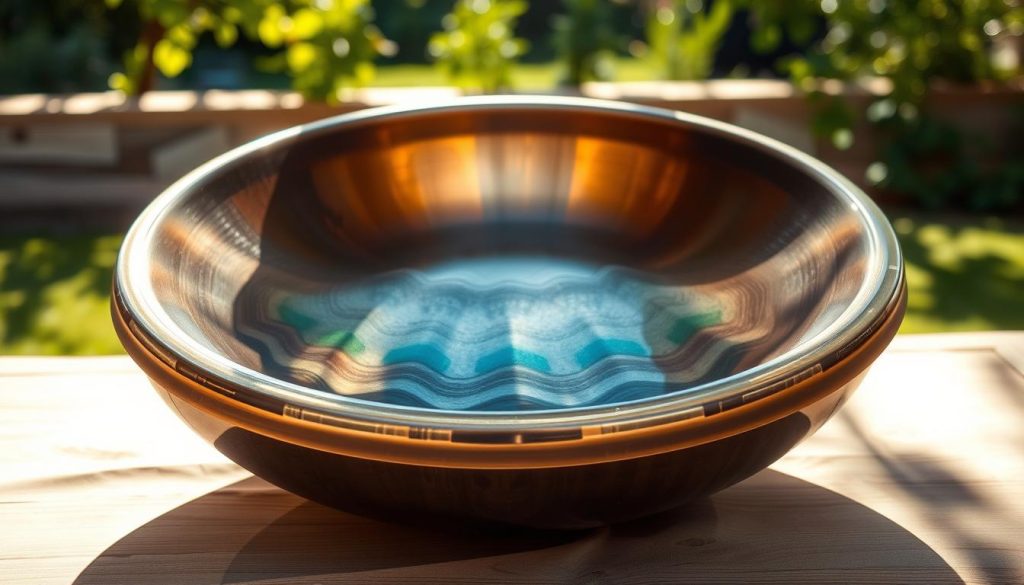
Shape and design: a sound sculpture
The handpan’s shape is the result of a meticulous process. The shells are pressed into shape and joined to create a harmonious outline. This design adds to the instrument’s visual appeal while playing a crucial role in its sound quality.
Materials: nitrided steel and stainless steel
The main materials used are DC04 nitrided steel and stainless steel. Nitrided steel undergoes treatment to improve its acoustic properties. Stainless steel is valued for its resistance to rust, which helps the instrument last longer.
The handcrafted shaping and hammering process
Making a handpan requires exceptional craftsmanship. The shells are hammered for dozens or even hundreds of hours. Each hammer blow contributes to the precise tuning of the notes, making every instrument unique.
The shells are between 1 and 1.2 millimetres thick, allowing them to vibrate freely. This thinness is essential for a sensitive acoustic response to the touch of a hand.
Each handpan is a handcrafted piece whose price reflects the time and quality involved in making it. Nitrided steel and stainless steel models differ in sound and durability.
| Characteristic | Nitrided steel | Stainless steel |
|---|---|---|
| Acoustic properties | Excellent | Good |
| Rust resistance | Moderate | High |
| Durability | Good | Excellent |
| Shell thickness | 1 to 1.2 mm | 1 to 1.2 mm |
In short, making a quality handpan depends on skilled craftsmanship and carefully selected materials. These qualities add to the value of an instrument that continues to captivate music enthusiasts.
The handpan’s structure and components
The structure of this unique instrument includes several key parts that contribute to its distinctive sound. Each part helps produce the enchanting tones for which this instrument is known.
The Ding: the central note
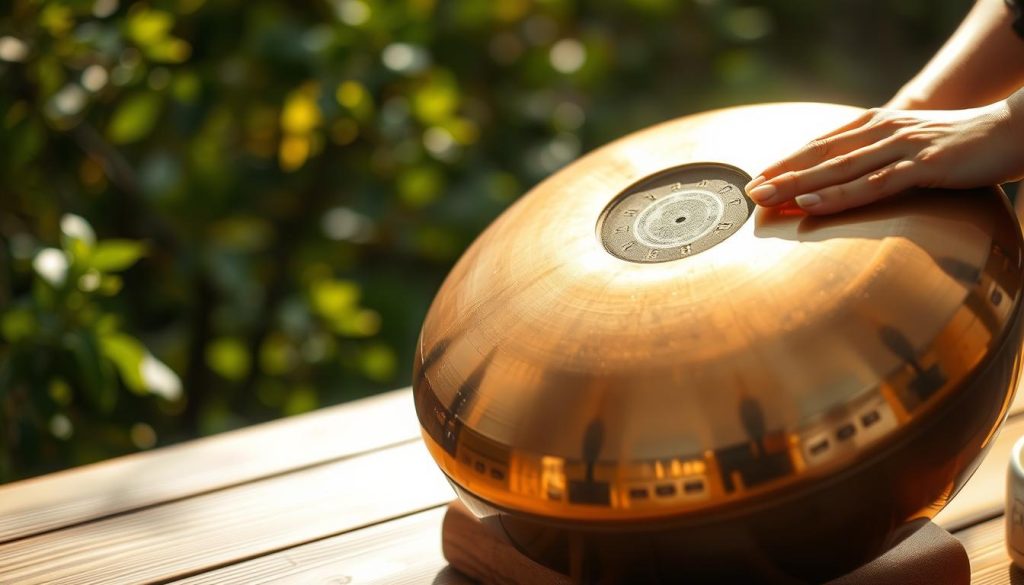
The Ding is the central area and is usually the lowest note. It may be convex, known as an apex ding, or concave, known as an inpex ding. The maker’s preference determines its shape, which influences the instrument‘s tone.
Tonefields and their role in tuning
Tonefields are flat, oval or round areas around the dimples. They are the main playing surfaces used to produce musical notes. Their positions and sizes are essential to the instrument‘s tuning and sound quality.
Dimples, shoulder, rim and other areas
Dimples are indentations at the centre of each note. They help reduce unwanted frequencies and balance the sound. The shoulder forms the transition between the Ding and the untuned spaces between notes.
The rim, or flange, is the edge where the two shells meet. It contributes to the instrument‘s structure and resonance.
The Gü: a resonance opening
The Gü is an opening in the lower shell, opposite the Ding. It lets sound escape and gives the maker access for tuning. It plays an important role in the instrument‘s acoustics.
Bottom notes on the lower shell
Additional notes, known as bottom notes, may be placed on the lower shell. They give musicians more sounds to work with and enrich the playing experience. These notes add another dimension to a performance.
In short, a handpan’s construction reflects meticulous craftsmanship. Every part contributes to an instrument admired for its beauty and musicality. To learn more about this instrument, read our complete handpan guide.
How does a handpan produce sound?
The sound of this instrument rests on fascinating acoustic principles. One is Helmholtz resonance, which involves air resonating inside a cavity. A simple example illustrates the phenomenon: when someone blows across the neck of a bottle, the resulting sound depends on the volume of air inside it.
The physics of Helmholtz resonance
With a handpan, a light strike on the metal creates vibrations. These vibrations travel through the air and produce enchanting sounds. The shells, which are between 1 and 1.2 millimetres thick, are made so that even a gentle touch can set them vibrating.
Metal vibrations and the resonating chamber
This instrument consists of two joined shells that form a resonating chamber. This design amplifies vibrations and enriches the harmonics of its notes. Each strike on the metal creates an interaction between the surface and the air, producing a distinctive sound.
How note size affects pitch
The size of the tonefields also matters. A larger note produces a lower sound, while a smaller one produces a higher sound. This relationship between size and the pitch of the notes is fundamental to the instrument‘s musical character.
How touch affects the acoustic response
How the musician plays the handpan is equally important. Striking near the junction of a tonefield and its dimple can produce a clear tone. The Gü, the opening in the lower shell, also allows air to move, enriching the sound.
- Helmholtz resonance helps explain how the sounds are produced.
- The bottle comparison shows why the volume of air matters.
- The thin metal shells create vibrations when struck gently.
- The resonating chamber amplifies vibrations and harmonics.
- The size of the tonefields determines the pitch of the notes.
- Striking different areas produces varied sounds.
- The Gü allows air to move and provides access for tuning.
To learn more about how this instrument works, read our detailed article on how the handpan works.
Handpan notes, scales and tuning
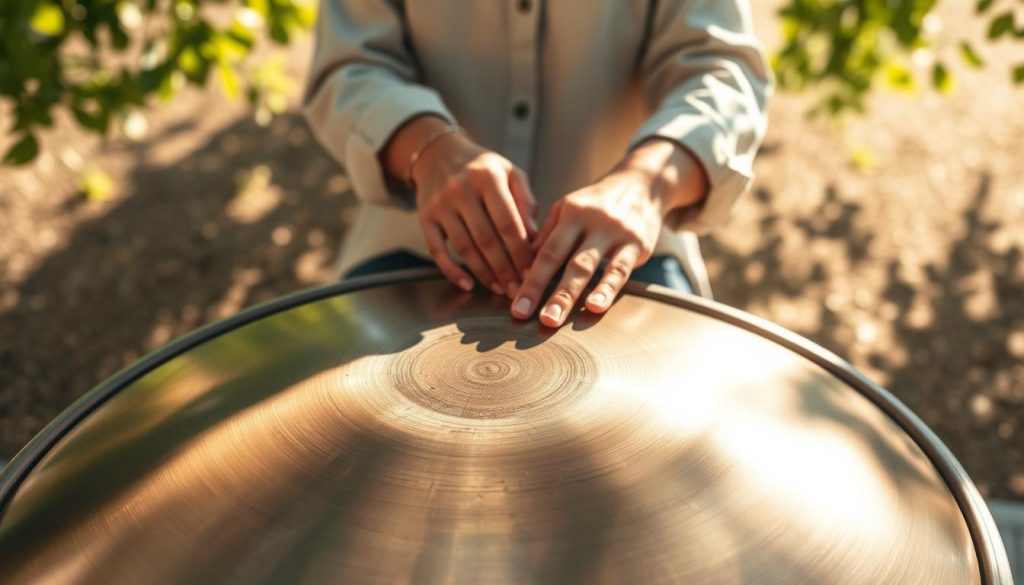
This instrument‘s rich sound depends on its notes and tuning. Handpans are generally tuned to a diatonic scale. This gives them a defined range of pitches and a distinctive musical character.
How diatonic scales are organized
A diatonic scale has seven distinct notes in an octave, separated by five whole steps and two half steps. Unlike a chromatic scale, this arrangement provides a more limited set of pitches that can be easy to explore. For example, a handpan tuned to a D minor scale offers the notes built into that instrument.
Number and arrangement of notes on a handpan
Handpans can have between 8 and 15 notes. For beginners, 8 notes, including the central Ding, are often enough. The notes generally alternate to the left and right of the Ding as their pitch rises. This arrangement makes it easy for musicians to move from one note to another.
Common reference pitches: 440 Hz and 432 Hz
Two reference pitches are common. A4 at 440 Hz is the standard choice and is useful when playing with other musicians. A4 at 432 Hz is sometimes chosen for holistic and meditation practices. The choice can affect how the instrument fits with other music and how the player experiences its sound.
How tuning affects playing and music
Tuning has a major effect on how this instrument is played. A diatonic handpan reduces the chance of playing clashing notes, making it easier for beginners to learn. Each tonefield is carefully tuned so its fundamental, octave and fifth contribute to a rich, deep sound.
Choosing a tuning when buying a handpan is essential because it determines the musical possibilities available to the player. Whether it uses a major, pentatonic or more unusual scale, each instrument has its own character.
To learn more about notes and tuning, read our detailed article about handpan notes.
Handpan instrument: how it works, notes and distinctive features — a guide to choosing and playing one
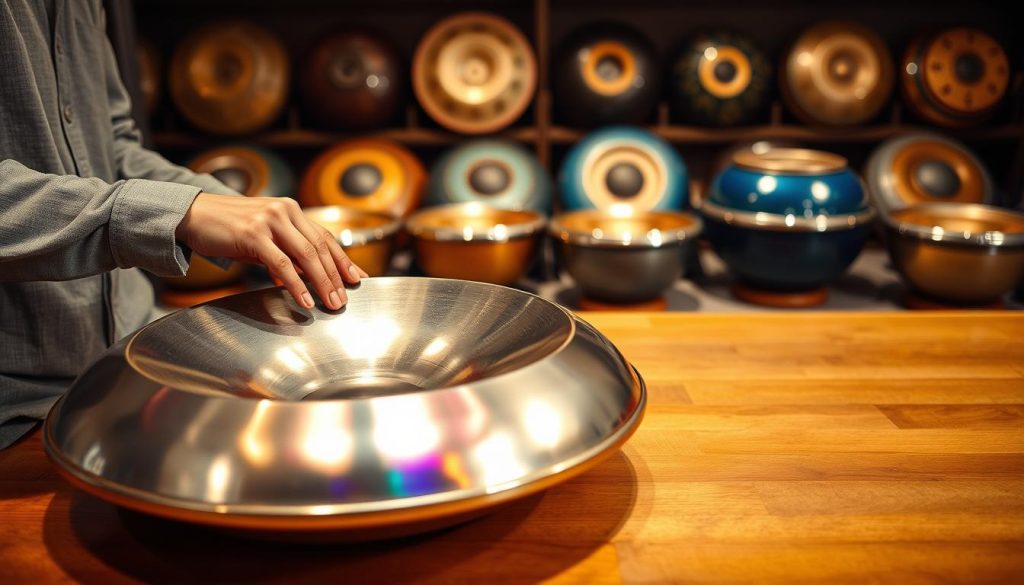
Choosing a quality handpan takes care. Many models on the market have poor acoustics. To avoid disappointment, consider reputable shops such as Instruments du Monde, which offer well-made handpans.
How to choose a quality handpan
When you are considering buying a handpan, take several factors into account:
- Number of notes: Models have between 8 and 15 notes, depending on your needs.
- Tuning: Check whether the model uses A4 at 440 Hz or 432 Hz, according to your musical preferences.
- Material: Nitrided steel handpans sound different from stainless steel models; stainless steel is more resistant to rust.
- Budget: Expect to spend between €1,000 and €1,500 on an entry-level model.
Main playing techniques and posture
The handpan is played mainly with the hands, although other methods are possible. Common techniques include:
- Thumb technique: Strike the side of the handpan, then quickly lift your hand away.
- Index and middle finger technique: Use these two fingers to strike the notes.
- Using mallets: They create a more percussive effect but may cause the instrument to go out of tune sooner.
It is useful to play while seated, with the handpan resting on your lap. This gives you a comfortable posture and lets your hands move freely.
Practical uses: relaxation, meditation and music therapy
The handpan is widely used in holistic practices, including:
- Relaxation: Its soothing sounds can help create a sense of calm.
- Meditation: Its harmonious tones can help people focus and settle their attention.
- Music therapy: The instrument can be used in activities intended to support mental and emotional well-being.
In these settings, people often associate the handpan’s sound with restorative qualities.
Caring for and tuning your handpan
Proper care helps preserve your handpan’s sound quality:
- Rust protection: Stainless steel models need less maintenance than nitrided steel ones.
- Cleaning: Use suitable products to avoid damaging the surface.
- Transport: Protect the instrument from impacts that could affect its tuning.
If it needs retuning, consult a professional.
To learn more about how this instrument works, read our detailed article on how the handpan works.
Conclusion
This beautiful sound sculpture reaches beyond familiar musical categories. Its distinctive shape and captivating sounds make it more than an ordinary musical instrument. Easy to play, it lets people express themselves intuitively without prior knowledge.
Choosing a quality model is essential if you want to enjoy its enchanting sound fully. Over the years, the instrument has grown into a worldwide musical phenomenon. Whether used for relaxation, meditation or music-making, the handpan offers a unique experience.
Explore this fascinating world and discover how a few notes can become memorable musical moments. Share your enthusiasm with other musicians and develop your creativity.