
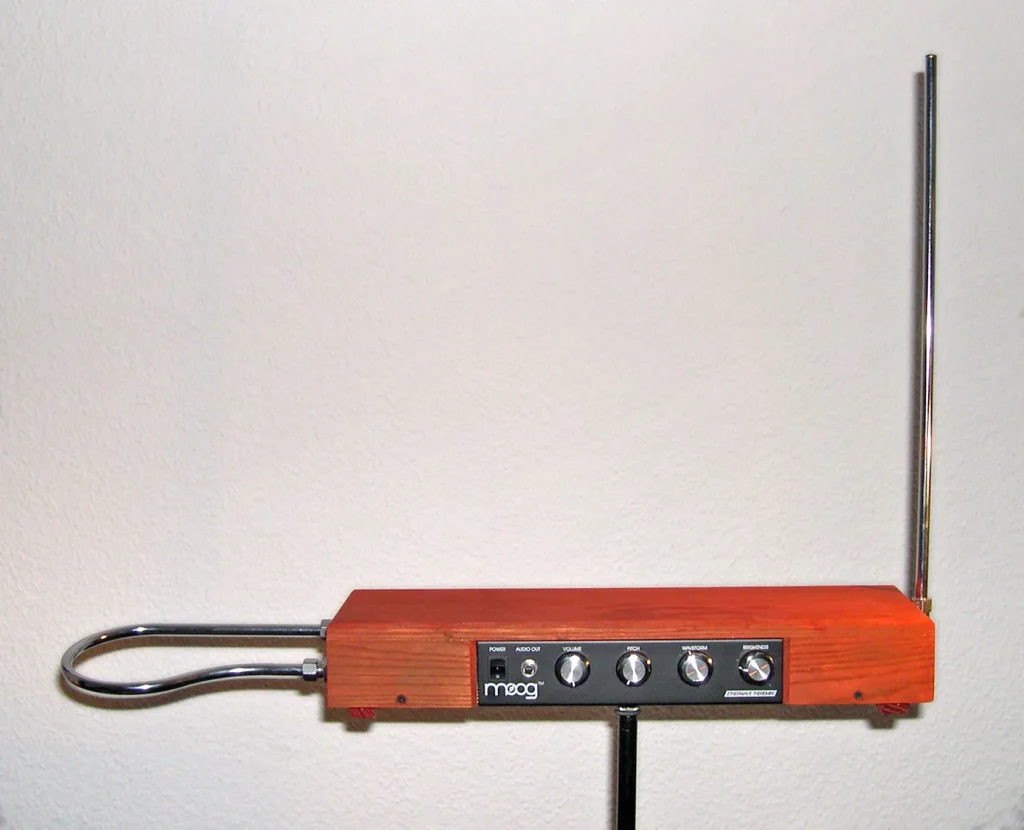
The theremin is a unique electronic musical instrument played without touching it. Invented nearly a hundred years ago by Lev Sergeyevich Termen in St. Petersburg, it has captivated audiences. It is especially valued in contemporary music for its pure, ethereal sound.
The theremin has two antennas and an electronic cabinet. It can span approximately seven to eight octaves. Although producing sounds is simple, mastering the theremin takes practice. You need to understand how to manipulate frequencies and practice regularly to improve your musical skills.
What Is the Theremin?
The theremin is a unique electronic instrument. It was invented in 1920 by Leon Theremin. This mysterious instrument uses electromagnetic fields to control sound.
Despite its age, the theremin continues to captivate audiences. It features in contemporary music and has a fascinating history.
Origins and Invention
Leon Theremin, a Russian engineer, created the theremin. He began by measuring the density of gases. After a demonstration for Lenin, the theremin became a musical instrument.
This invention marked a milestone in the theremin’s history. It is considered the world’s first electronic instrument.
Instrument Features
The theremin stands out for its two antennas, which control pitch and volume. It can produce a wide variety of notes and has a tone reminiscent of the human voice.
The theremin’s features, such as its heterodyne oscillator, allow it to produce pure sounds. Its intuitive design lets people play without traditional musical knowledge. This makes the instrument accessible in modern music.
| Feature | Details |
|---|---|
| Number of octaves | Approximately 7 to 8 octaves |
| Oscillator type | Vacuum-tube heterodyne |
| Tone | Resembles the human voice or musical saw |
| Frequency range | 20 to 20,000 Hz |
Artists such as Radiohead and M83 use the theremin. This instrument continues to evolve in today’s music. To learn more, see this page.
How Does a Theremin Work?
The theremin works through electromagnetic principles. It lets you create melodies by manipulating electromagnetic fields without touching the instrument.
Electromagnetic Principles
The theremin works using radio-frequency oscillators. These oscillators create electromagnetic fields around the antennas. When a musician moves closer, the pitch and volume change.
The Role of the Antennas
The theremin’s antennas play a crucial role in producing sound. The vertical antenna controls pitch. The loop antenna adjusts volume. Moving closer to the pitch antenna makes the sound higher. Moving closer to the volume antenna increases the sound’s intensity.
Producing Sound Without Touching the Instrument
Sound is produced without touching the instrument through a capacitive effect. The musician’s body acts as an electrode. This makes it possible to create unique sounds resembling a voice or an electric violin. Its sonic possibilities are endless, attracting many artists.

| Element | Role |
|---|---|
| Vertical antenna | Controls pitch |
| Loop antenna | Controls volume |
| Musician’s body | Acts as an electrode to produce sound |
| Oscillators | Generate electromagnetic fields |
Theremin: How to Master This Touchless Instrument
The theremin is a unique instrument played without touching it. Learning to play it calls for a particular approach. You need to practice to master the necessary movements.
Learning the Basics of Hand Control
Understanding how to play the theremin is essential. You must control two antennas to adjust pitch and volume. Your movements need to be smooth to produce an accurate sound.
Start with simple melodies. Use online resources, such as these theremin learning sites.
Tips for Developing Your Skills
Regular practice is essential for improvement. Experiment with different techniques. Online videos and tutorials offer useful advice.
Listen to artists such as Stromae and the Beach Boys. They may inspire you. Meet other musicians to exchange ideas and stay motivated.
The Importance of Regular Practice
Regular practice is essential for improvement. It develops coordination and your musical ear. A structured practice plan helps you progress.
Plan short but frequent sessions. Your progress will become more noticeable. Online resources about electronic music are useful for exploring this instrument.
| Aspect | Description |
|---|---|
| Origin | Invented by Leon Theremin in 1920. |
| Technique | Manipulating magnetic fields to play without touching the instrument. |
| Playability | Highly challenging and requires patience. |
| Range | Can cover up to nine octaves. |
| Uses | Featured in films, musical theater and contemporary bands. |
Playing Challenges and Tips for Overcoming Them
Playing the theremin is difficult, especially when it comes to coordination and precision. It requires considerable physical control. Musicians must adjust their position to produce the sound they want.
This can be difficult for beginners, who struggle to balance movement and sound.
Coordination and Precision
Playing the theremin well requires good hand coordination. You also need to judge distances. Movements must be smooth and precise.
Practicing often helps you improve. Exercises that develop spatial awareness can be useful and help you play better.
Common Mistakes to Avoid
Beginners often struggle to play in tune. They focus too much on pitch, even though volume is equally important.
You need a good ear to play well. To learn more, you can read this journal.