
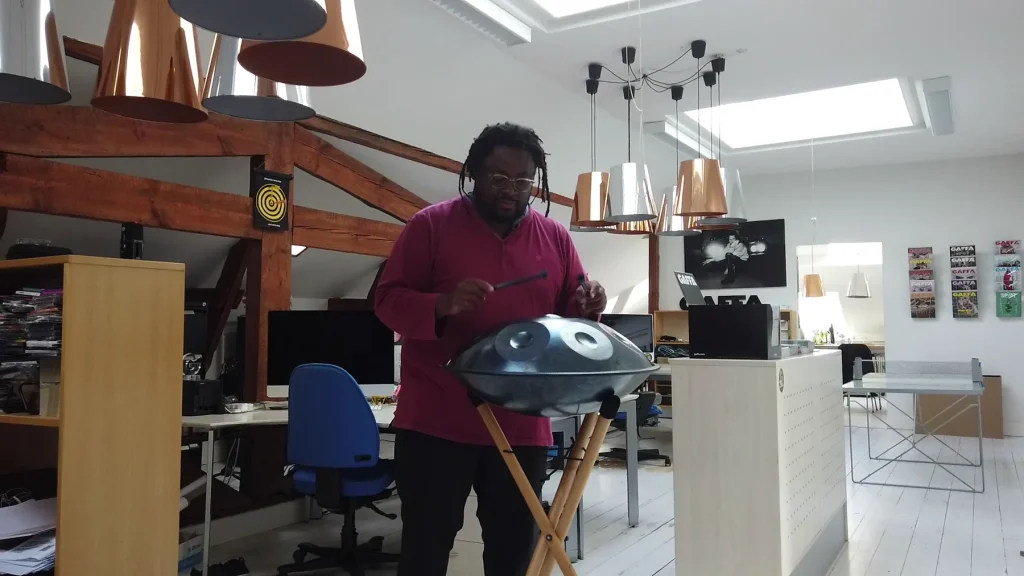
The handpan is a fascinating instrument that is attracting more and more musicians and music lovers around the world. Its unique, flying saucer-like design conceals a remarkable range of sounds. Designed to be played by hand, it offers an intuitive experience that is ideal for beginners.
This guide will help you explore the world of the handpan. We will look at its origins and features, along with practical advice on choosing the right model. With its captivating sounds, this instrument lends itself to relaxation and meditation.
We will also explain why it is important to do your research before buying your first handpan. A thorough understanding can help you avoid pitfalls and find an instrument that suits your musical tastes. We hope this guide makes the journey rewarding for every reader.
Introduction to the handpan: Origins and features
A new musical world emerged from a Swiss invention. The handpan, created in 2001 through PANArt’s innovation, quickly captivated music lovers. Its distinctive structure, made from two steel shells, gives it both its striking appearance and its remarkable sound.
Every handpan has a central note called the “ding,” surrounded by several notes arranged in a circle. Unlike instruments such as the piano, a handpan has a limited number of notes belonging to a single scale. The notes around the outer circle are often arranged in a zigzag pattern, making the instrument intuitive to play.
It is important to understand that “hang drum” is an inaccurate term. The Hang®, developed by PANArt, is the handpan’s predecessor. It should not be confused with a drum: it is a melodic percussion instrument. An opening called the Gu in the lower shell amplifies the sound and projects the bass frequencies, enriching the acoustic experience.
The handpan also differs from steel tongue drums. While those instruments have cut-out tongues, a handpan is shaped and hammered throughout. This gives it a richer tone and a longer sustain, allowing players to create captivating melodies.
Since 2012, the market has grown rapidly, from around 30 makers to more than 300 today. That has made the instrument more accessible, but it also calls for greater care when buying one. Because its notes belong to a diatonic scale, beginners can create beautiful melodies without any prior musical knowledge.
In this article, we will cover the main criteria for choosing a handpan: scale, tuning frequency, sustain, material, number of notes, and budget. Understanding these factors will help you make an informed choice and find the instrument that suits you best.
Understanding handpan scales
A handpan’s scale plays a fundamental role in the musical experience it offers. It shapes both the mood and the emotions you can express through the instrument. Each scale is a set of notes that work together to create distinctive melodies.
Types of scales: Major, minor, and Eastern
Scales generally fall into three categories. Major scales are often associated with bright, cheerful sounds and are well suited to uplifting music. Minor scales, by contrast, have a more melancholy and introspective character that can be ideal for meditation.
Eastern scales, such as Hijaz and AkeBono, add a mystical quality. They can, however, limit your playing options. Choosing a scale that fits your personal preferences is therefore essential.
Which scale should you choose as a beginner?
For beginners, D minor (Kurd) is often recommended. Players value its emotional richness and how easy it is to learn. Other common choices include AmaRa, Integral, and Magic Voyage, all of which are minor-mode scales.
Listen to several performances on YouTube and note which scales you feel a strong emotional connection to. This can help you narrow down your choice. Above all, the right scale is the one that feels right to you.
Each scale brings its own character to your playing. Take time to explore different sounds and choose the one that resonates with you most.
Tuning frequency: 432 Hz or 440 Hz?
When choosing an instrument, tuning frequency is an important consideration. The two main options are 432 Hz and 440 Hz. Each has characteristics that can affect your musical experience.
Advantages of 432 Hz tuning
432 Hz is often described as a “natural frequency.” Its supporters claim that it encourages a deep connection with the universe and nature. It is also considered calming, making it a popular choice for relaxation and meditation.
Some players associate this frequency with a more intense emotional experience, and many musicians feel that it improves their artistic intuition. The article describes 432 Hz handpans as popular and widely available.
Advantages of 440 Hz tuning
By contrast, 440 Hz is the international tuning standard used by most symphony orchestras. It is widespread in modern music. A handpan tuned to 440 Hz is easier to play alongside other conventionally tuned instruments, which makes group performances simpler.
Some players perceive this tuning as more dynamic and intense, particularly in concerts. Its compatibility with other instruments gives musicians greater flexibility when collaborating.
A handpan tuned to 432 Hz cannot readily play in tune with one tuned to 440 Hz. For beginners who want the freedom to play with other musicians, a 440 Hz model is generally the more practical choice.
If you are still unsure, contact an expert or a maker. They can give you information tailored to your musical needs.

Sustain: Duration and its effect on playing
A handpan’s sound quality depends in large part on how long its notes sustain. Sustain is the time a note continues to ring after it is struck. It is a key part of the instrument‘s distinctive sound.
Longer sustain allows deeper resonance and more opportunities to explore harmony. Too much sustain, however, can cause notes to blend in unwanted ways. A sustain of around 8 to 12 seconds generally offers a useful balance between resonance and clarity.
What sustain is and why it matters
Sustain directly affects harmonic richness and your ability to layer notes. Learning to use it can make playing more rewarding. Notes with very short sustain may sound abrupt, while notes that ring for too long can overlap and obscure the harmony.
What sustain is best for beginners?
Beginners are generally advised to choose a handpan with medium sustain. It lets you work on your striking technique without the sound becoming muddy. Short sustain can be difficult to work with, while long sustain calls for more advanced control.
Your ideal sustain also depends on your playing style. Try different handpans to discover which one best suits your musical preferences.
| Type of sustain | Characteristics | Best for |
|---|---|---|
| Short sustain | Limited resonance, abrupt sound | Advanced musicians |
| Medium sustain | Good balance, clear resonance | Beginners |
| Long sustain | Deep resonance, risk of overlapping notes | Experienced musicians |
How to assess a handpan’s sound quality
Before buying a handpan, assess its sound quality. Two main factors deserve attention: the balance between its notes and crosstalk. Both affect the playing experience and your satisfaction with the instrument.
Balance between notes
The balance between notes is crucial. Each note should sound clear and distinct, even when played softly. No single note should overpower the others. To test the balance, play every note on its own and then together with other notes. Listen for whether the overall harmony remains clear.
Understanding crosstalk
Crosstalk occurs when striking one note unintentionally makes another vibrate. A good handpan keeps this effect almost imperceptible. Too much crosstalk can make your playing sound unclear, although controlled crosstalk can also create rich harmonics.
For beginners, a model with minimal crosstalk is easier to learn on. Each note around the outer circle should produce a consistent sound wherever you strike it, apart from its central dimple.
On a well-tuned instrument, each note also resonates with three tuned pitches: the fundamental, the fifth, and the octave. Together, they create a distinctive harmonic richness.
Before deciding, ask for a recent recording in which every note is played slowly and individually. It will help you assess these aspects of sound quality.

Materials and their effect on sound
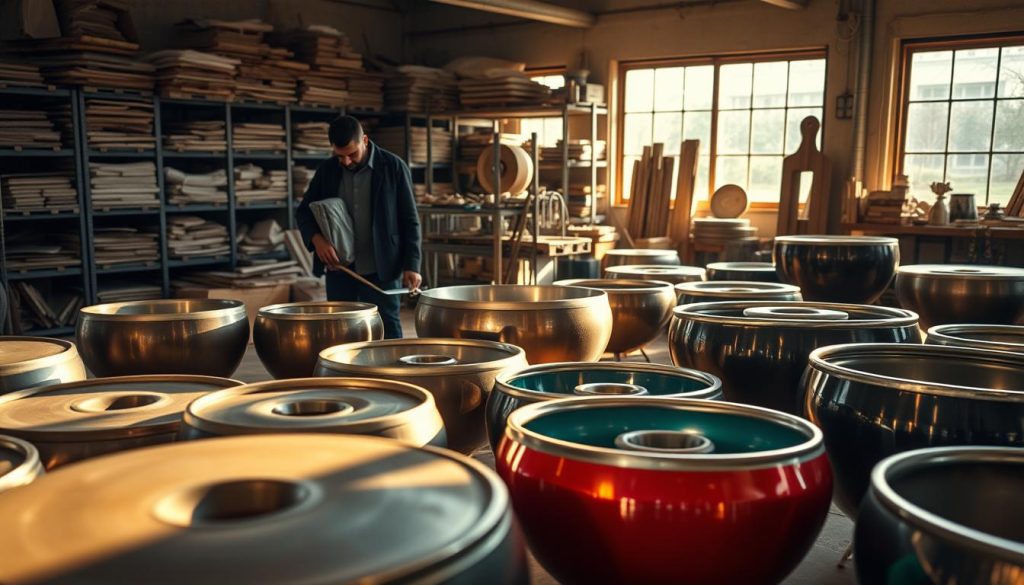
The material used to make an instrument matters. It affects sound quality, durability, and maintenance. Nitrided steel and stainless steel are among the most common choices, and each has distinct characteristics.
Nitrided steel or stainless steel
Nitrided steel is treated with nitrogen to create a protective layer that resists corrosion. It can produce a rich, warm, deep sound with appealing harmonics. Its longer sustain can be particularly suited to meditative and relaxing music.
Stainless steel offers excellent corrosion resistance and does not require regular oiling. It produces a brighter sound and, as described here, a shorter sustain that can suit rhythmic, energetic playing. It is generally less expensive than nitrided steel.
Here is a comparison of the two types of steel:
| Type of steel | Sound characteristics | Advantages | Disadvantages |
|---|---|---|---|
| Nitrided steel | Rich, deep sound and pleasing harmonics | Long sustain; well suited to meditation | Requires regular oiling |
| Stainless steel | Bright, clear sound | Easy to maintain; no regular oiling needed | Shorter sustain and a less enveloping sound |
Which material should a beginner choose?
Beginners should try handpans made from both materials before deciding which sound they prefer. Most makers use steel around 1.0 mm thick, though some offer 1.2 mm models that produce a softer sound and cost more to make.
Ultimately, your choice between nitrided and stainless steel depends on the sound and playing style you prefer. Consider long-term maintenance costs too: nitrided steel needs regular care to help prevent corrosion, while stainless steel is easier to maintain.
Choosing the right number of notes for your level
When buying a handpan, the number of notes is an essential consideration. The right choice depends on your musical level, goals, and budget. Notes are counted in two ways: some people include the central ding, while others do not. Thus, “9 notes” can mean eight notes around the circle plus the ding, also written as “8+1.”
Handpans with 9 notes or fewer
Models with 9 notes or fewer are well suited to beginners. They are quick to get to grips with and do not overwhelm the player with options. They may also be easier to tune consistently, reducing the risk of sound defects.
- Clearer notes can make harmonious playing easier.
- A gentler learning curve suits newcomers.
- A smaller set of notes may eventually feel limiting.
Handpans with 10 notes or more
Models with 10 or more notes may suit intermediate or experienced musicians who want to explore more complex melodies and playing techniques. They also have potential drawbacks.
- There is a greater risk of tuning problems and interference between notes.
- Higher notes may be quieter, affecting the overall sound.
- A higher price may put some models out of reach.
For a first purchase, consider a model with at least eight notes around the circle, excluding the ding, but no more than nine. This offers a useful balance of musical potential and sound quality. These details on choosing the number of notes can help you refine your decision.
Having fewer notes does not necessarily limit your music. Different playing techniques can produce a variety of sounds from the same note. Take time to explore and choose the model that suits you best.
Handpan prices: What budget should you plan for?
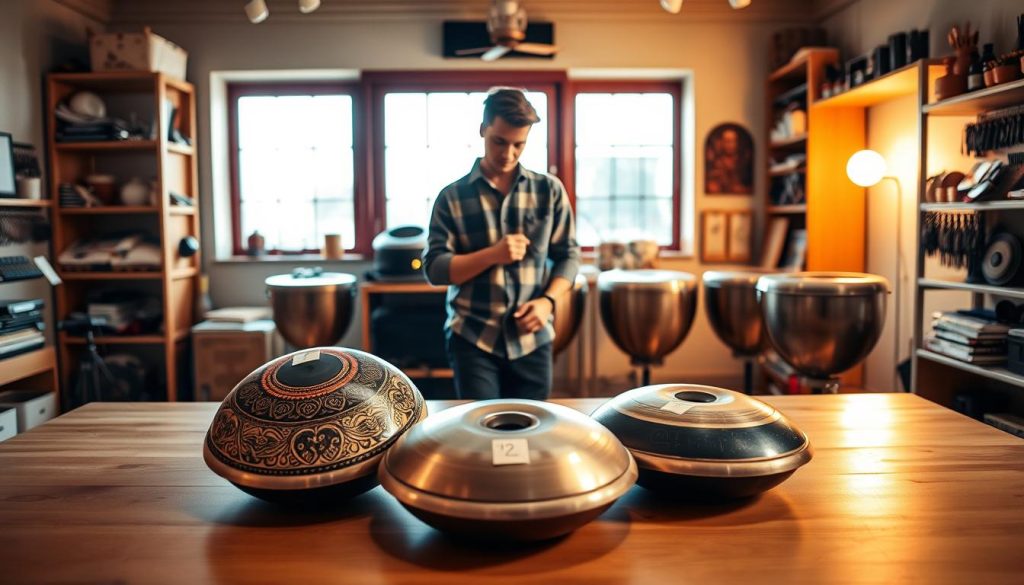
Handpan prices vary considerably. Understanding why will help you plan your purchase. The price of an instrument reflects the time, technical difficulty, and expertise involved in making it.
The main factors affecting price are:
- The number of notes: more notes make tuning more delicate and increase the cost.
- The presence of low notes: these require lengthy, complex work and therefore cost more.
- Tuning quality: good tuning takes several rounds of careful adjustment.
- The maker’s reputation: established makers often invest in training and sound research.
An unusually cheap handpan may involve compromises, such as unstable notes, uneven sustain, or poor-quality steel. As a general guide, a good model costs between €900 and €1,400. Expect to pay €1,400 to €2,000 for a mid-range handmade model. High-end models with low notes can cost €5,000 or more.
A high price does not always guarantee quality. A poor-quality instrument can still sell for €1,200 to €2,500. Watch for these warning signs:
- An unusually low price.
- No demonstration recording.
- No retuning service.
- Blurry or generic photos.
A good maker or reliable shop will offer a retuning service you can access. This helps ensure the instrument lasts. For beginners, the good news is that the market has become more accessible: you can now buy a good handpan without waiting years or spending a fortune.
Plan to spend at least €900 on a good first handpan, and check the seller’s reputation before deciding.
Practical tips for buying your first handpan
Buying a new instrument can be exciting, but it also takes preparation. These tips will help you make a sound choice.
Before deciding, watch plenty of demonstrations. They will help you get to know the different sounds and models available. If possible, try an instrument in a shop or at a workshop. Playing it yourself will give you a better sense of what suits you.
If you are unsure, consider renting a handpan before buying one. That gives you time to confirm your choice without pressure.
Check the warranty too. Aim for at least 12 months, and review the return terms—ideally, a 14-day period for a full refund. This can protect you if a problem arises.
Keep your proof of purchase and provenance, including invoices and demonstration recordings. They may be useful for after-sales service or a future resale.
Protecting your instrument is essential. Keep your handpan out of direct sunlight and excessive heat, which can affect its tuning. Play with your fingers rather than sticks, and wash your hands before each session.
If your instrument gets wet, dry it immediately. Remove rings, watches, and other jewelry before playing to avoid scratches.
Do not leave your handpan in its case all the time. The case is intended for transport; prolonged storage inside it can encourage rust.
Oil your instrument regularly unless it is made of stainless steel. Never put the handpan down with its notes facing the floor.
The sound also changes with temperature: it can be higher-pitched in cold conditions and duller in warm ones. This is part of the playing experience.
Buy from a reliable seller who offers after-sales support. If you are considering a used instrument, request a recent recording of every note played separately and check its history. Be wary of very low prices, which can conceal defects.
Conclusion
Choosing your first instrument is an exciting journey. Consider both the sounds you prefer and the technical features. This intuitive instrument can produce beautiful melodies within minutes, even if you have no previous musical experience.
A lively community has grown around the handpan and offers valuable support to beginners. Online resources, including YouTube performances and forums, can help you progress at your own pace. Explore different scales and try several models.
The instrument offers more than music alone: it can support relaxation and meditation while giving you room for creative expression. After a few months of practice, you might consider a second model to explore new sounds and expand your musical possibilities.