
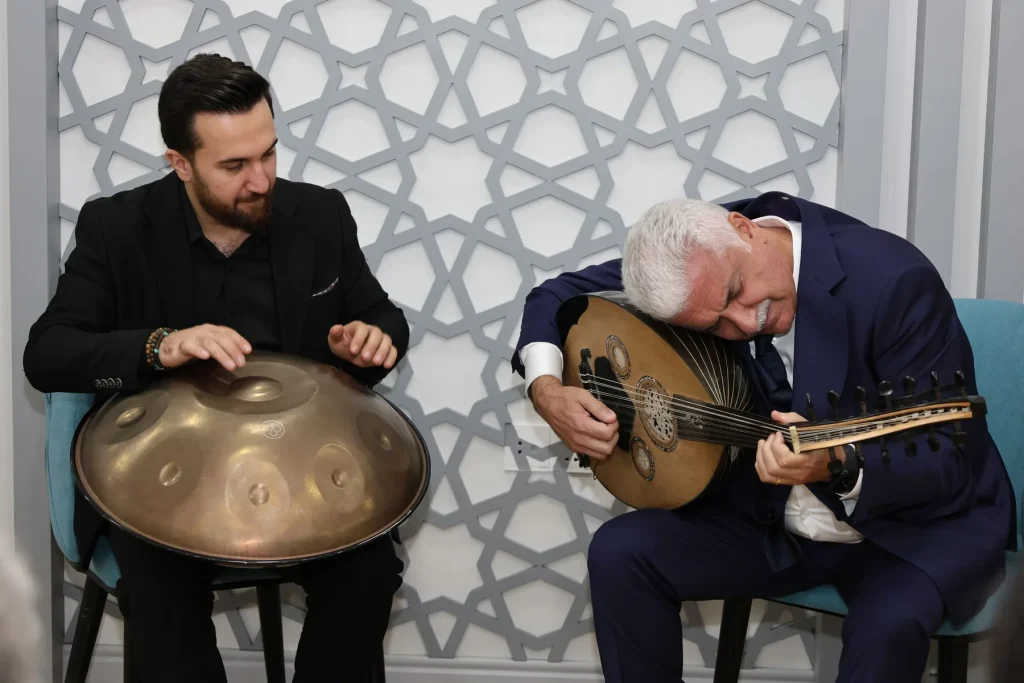
The handpan is a fascinating instrument that captures attention with its ability to produce enchanting harmony from the first few strikes. Made of nitrided steel, it is tuned to a diatonic scale, allowing almost anyone to create beautiful melodies without prior musical knowledge.
This unique instrument offers a rich sonic experience: each note resonates and spreads, creating a captivating tonal balance. This invites us to understand how the sounds interact to form harmony.
As well as being a musical tool, this instrument can support well-being and spiritual connection. The music it produces can deeply move listeners and give them a moment of serenity and reflection.
In this article, we will cover the handpan’s physical structure, advanced playing techniques, different scales, and tuning. The handpan is accessible and makes it possible to create harmonious melodies in a short time.
Introduction to handpan harmony: the essence and impact of notes
The magic of this instrument lies in its ability to offer a musical experience that is accessible to everyone. In just one hour, a beginner can start creating captivating melodies. Each model is designed with a specific set of notes that defines its scale and harmonic potential.
These notes are carefully selected for their inherent harmony. They form a coherent set and interact smoothly when played together. This quality makes the handpan a unique instrument that encourages improvisation.
Here are some key points about the importance of harmony:
- Definition of harmony: a coherent sound in which each note naturally finds its place within the whole.
- A solid harmonic foundation: tuned notes allow even beginners to make pleasing music without prior knowledge of theory.
- Emotion and technique: handpan harmony can deeply move the listener.
- Impact on well-being: the resonance of the notes can bring a sense of calm and connection with oneself.
- Natural perception: the human ear instinctively perceives harmony, which this instrument uses to create an immersive sonic experience.
- Stress reduction: the handpan’s music can encourage a meditative state through its harmonic stability.
- Appreciation over time: each playing session deepens one’s perception of harmony.
- Number of notes: the harmony rests on a specific number of notes carefully selected to work together.
In short, this instrument is more than a musical tool. It opens the door to a world of serenity and personal expression. To learn more about how instruments are made and tuned, read this article.
How a handpan produces sound: from notes to vibrations
The design of this instrument creates a unique sonic experience. Its sounds result from the vibration of tone fields formed on its surface. Each field has a different size: a larger field produces lower notes, while a smaller one produces higher notes.
The notes resonate inside the cavity formed by the instrument’s two halves. They are naturally amplified and projected through the opening on the underside, often called the Gu. This opening plays an essential role in projecting sound and allows the vibrations to spread through the space.
Physical structure and resonance of the handpan
The handpan’s physical structure is fascinating. It consists of two joined nitrided-steel shells that create a resonance chamber. This chamber naturally amplifies the vibrations produced by each note.
How dimples produce notes
The dimples, or inverted depressions in the steel, are carefully sized. Each dimple is tuned to produce a specific note when struck. Thus, the size of each dimple helps determine the pitch, from the lowest sounds to the highest.
The role of the underside opening in projecting sound
The underside opening, or Gu, is an essential feature. It allows sound to spread and contributes to the instrument’s projection. The inner cavity acts as a resonance chamber, amplifying the notes and blending them harmoniously.
Handpan makers play a decisive role in the richness of the sound. They tune overtones that add depth to each note. Their skill enables them to create instruments capable of producing remarkably pure sounds.

In short, the physical structure, dimples, and underside opening together define the handpan’s sound. Each feature contributes to a captivating and immersive musical experience.
Notes and scales: the handpan’s harmonic foundation
The instrument’s rich sound rests on the structure of its scale. A diatonic scale consists of seven pitches, with five whole steps and two half steps per octave. It provides an essential harmonic foundation for musical performance.
Definition and characteristics of the diatonic scale
The diatonic scale organizes pitches in a precise way. Notes repeat in each octave, allowing musicians to move easily between registers. On an eight-note instrument, the central Ding is the fundamental note around which the other notes are arranged.
How notes are arranged: octaves, fifths, and other intervals
Intervals such as fifths play an essential role in building harmony. For example, the relationship of a fifth between two notes is perceived as particularly stable by the human ear. It creates a sense of harmony and fullness that enriches the musical experience.
Octaves also allow the same note to be heard at different pitches, reinforcing the coherence of the whole. This structure encourages exploration of different configurations, such as a handpan in D minor or A minor.
Examples of common handpan scale configurations
Handpan scale configurations vary considerably. Here are some popular examples:
| Scale type | Configuration | Number of notes |
|---|---|---|
| D minor (D Kurd) | 3 × D, 2 × A, 2 × C | 10 |
| A minor | Varies by model | 8 to 10 |
| C major | Various configurations | 8 to 20 |
The more notes an instrument has, the more complex its tuning becomes. The number of notes can also affect its harmonic possibilities.
By exploring different scales, musicians can discover new facets of their art. To deepen your knowledge of scales, read this article.
Overtones: enriching and balancing the handpan’s sound
When a note is struck on this instrument, it does not produce just one sound. In fact, three distinct tones emerge: the fundamental, its octave, and the fifth above that octave. This combination enriches each note, giving it greater depth and resonance.
Overtones are essential to this richness of sound. They can be isolated and played separately, allowing musicians to explore different textures. The octave and fifth must be accurately tuned to ensure a stable, precise sound.
The nature and origin of handpan overtones
Each note struck on this instrument produces three tones at once. The fundamental is the main note, while the octave is the same note one octave higher. The fifth above the octave adds another dimension.
How overtones affect the perception of harmony
Overtones enrich our perception of harmony. They add depth and complexity to the sound, making it warmer and more enveloping. The fifth, a naturally consonant interval, contributes to the harmonic stability of each note.
Using overtones in advanced playing
Experienced musicians can use these overtones to vary their chords. Advanced playing techniques make it possible to isolate and play overtones separately, creating distinctive sound effects. This opens up many harmonic combinations and further enriches the instrument’s resonance.
To deepen your understanding of scales and playing techniques, read this article.
| Harmonic components | Description | Effect on the sound |
|---|---|---|
| Fundamental | The main note played | Foundation of the sound |
| Octave | The same note one octave higher | Adds depth |
| Fifth | A fifth above the octave | Harmonic stability |
Chords and harmonic progressions on the handpan
Playing this instrument makes it possible to create harmonious chords. Striking two notes at once produces an interval. A third or fourth note can be added to make more complex chords. These chords enrich the overall harmony.
Chord complexity varies with the arrangement of the notes on the instrument. The possibilities for chord progressions depend on the handpan’s scale. For example, a chord progression in D minor can offer a pleasing melodic flow.
Building chords from handpan notes
To build chords, you need to understand intervals. Thirds, fifths, and octaves create pleasing relationships between notes. Playing these intervals can provide a strong foundation for improvisation.
Using intervals and arpeggios to create melodies
Arpeggios involve playing the notes of a chord in sequence and offer countless melodic possibilities. They help create flowing, captivating melodies that enrich the musical experience.
How the scale shapes harmonic possibilities
Each arrangement of notes determines which chords can be formed. The scale therefore plays an essential role in exploring harmonic possibilities. Musicians can draw on educational resources, such as Amy Naylor’s videos on Handpan Connect, to deepen their understanding.
Here is an example of a chord progression on an instrument in D minor:
| Chord type | Configuration | Number of notes used |
|---|---|---|
| Major chord | D, F#, A | 3 |
| Minor chord | D, F, A | 3 |
| Power chord | D, A | 2 |
By experimenting with the number of notes played at once, musicians can find a balance between simplicity and harmonic richness. Regular practice with progressions is essential for developing harmonic intuition and creating personal compositions.
How playing technique and dynamics influence harmony
The way this instrument is played profoundly affects its sound quality and the harmony it produces. Gentle or forceful strikes change the harmonic texture. Each musician can create a distinctive atmosphere through their playing.
Striking techniques and note articulation
Musicians use different techniques to strike the notes. For example, playing with the fingers, thumbs, or other parts of the hand changes the articulation. This variety enriches the texture of the notes.
Effects on harmonic texture and tone color
The way notes are struck directly affects their tone color. A gentle strike produces a soft, intimate sound. A stronger strike increases volume and projection, transforming the listening experience.
Dynamic variation to shape the sonic experience
A good instrument offers a wide dynamic range: it responds to light strikes while retaining its sound quality. Changes in volume and intensity are essential for conveying emotion. A musician can practice playing the same melody at different intensities to explore these expressive possibilities.
The length of each strike and the speed at which notes follow one another also affect the overall perception of harmony. By varying these elements, musicians can create captivating melodies.
Finally, training the ear to hear subtle changes in dynamics helps refine playing and improve musical expression. Accessories such as gloves can also change the sound: the notes become shorter and quieter.

Handpan harmony: how do the notes create this balance?
Every sound produced by this instrument plays an essential role in the melody’s overall harmony. An instrument’s quality can be assessed in part by its timbre, the consistency of its sounds, and their volume.
Balance between notes: timbre, sustain, and volume
A quality handpan has a consistent sound: each note has a timbre and projection that fit with the others. Sustain is the length of time a note continues to sound after it is struck. For example, an instrument whose note rings for 10 seconds has more sustain than one that rings for only 6 seconds.
Preferences for sustain vary. Short sustain suits percussive playing, while medium sustain is ideal for most players. Those who play slowly and meditatively often prefer long sustain.
Note isolation and managing “crosstalk”
Crosstalk refers to unwanted interference between notes. When one note is played, its vibration should not cause another note to ring unpleasantly. Instrument makers must provide good isolation between notes while preserving desirable sympathetic resonance.
Unpleasant crosstalk should be distinguished from harmonious sympathetic resonance. For example, exciting a fifth can enrich the sound rather than disrupt it.
The importance of stability and harmonic consistency
Each note should remain accurately tuned and stable over time. Any drift would harm the instrument’s overall balance. Before buying a handpan, it is advisable to play the scale in order and check that no note stands out excessively or sounds muffled.
Imagine, for example, the sonic imbalance of a guitar with every other string replaced by twine.
| Evaluation criteria | Description | Effect on the instrument |
|---|---|---|
| Timbre | Consistency of sound | Affects the perception of harmony |
| Sustain | Length of resonance | Affects the listening experience |
| Crosstalk | Interference between notes | Can disrupt harmony |
| Stability | Consistent tuning | Maintains sonic balance |
Tuning and frequencies: 440 Hz, 432 Hz, and their influence on harmony
An instrument’s tuning plays an essential role in the quality of its sound. Most instruments use 440 Hz as the international tuning reference. However, many musicians prefer tuning to 432 Hz, which they often consider more natural.
Although the difference in frequency is subtle, some musicians feel it on a vibrational and emotional level. They often report a deeper connection with nature when playing an instrument tuned to 432 Hz.
Technical differences between 440 Hz and 432 Hz
Tuning to 440 Hz is widely used in modern music. It makes playing with other instruments easier. By contrast, some people perceive 432 Hz tuning as resonating with the vibrations of life and nature.
Although the difference can be hard to hear, it may affect how the body feels vibrations. Some musicians experience a sense of calm when playing an instrument tuned to 432 Hz.
Perceived effects on sensation and vibration
Many musicians believe that tuning to 432 Hz has healing properties. They feel it can give them a deep sense of well-being and spiritual connection. People who play meditatively often report this perception.
In some cases, musicians choose a tuning to suit their musical intention. For example, they might prefer 432 Hz for meditative solo playing.
Choosing a tuning to suit the musician’s preferences
The choice of tuning depends on personal preference and how the instrument will be used. Some musicians favor 440 Hz for compatibility with other instruments, while others choose 432 Hz because it feels gentler to them.
Tuning stability over time also matters. A good instrument holds its tuning, whether set to 440 Hz or 432 Hz, helping maintain lasting harmony.
It is advisable to be wary of poorly made instruments, whose tuning can deteriorate quickly and diminish both harmony and the pleasure of playing.
| Tuning type | Frequency | Perceived effect |
|---|---|---|
| 440 Hz | International reference | Compatible with other instruments |
| 432 Hz | Considered a natural tuning | Calm and spiritual connection |
Practical tips for developing handpan harmony
To develop your musical potential, it helps to explore theory and practice regularly. Understanding the relationships between sounds helps any musician make informed choices.
Studying and learning applied music theory
Studying music theory helps you understand how notes interact. It supports sound harmonic choices. A solid grounding in theory offers a better understanding of instruments and their possibilities.
Practicing progressions, transcription, and improvisation
Regular practice of chord progressions is recommended. Intervals, three- or four-note chords, and arpeggios are useful tools. Listening to and transcribing progressions played by other musicians enriches your musical vocabulary.
Making use of videos and online communities
Many free resources are available online. For example, David Charrier’s lessons are highly regarded. YouTube has many videos offering tips and advice for improving your playing.
Joining communities such as “French Handpan Connection” lets you share advice and experiences. These communities provide a space to exchange ideas and learn.
- Alternate technical exercises with free improvisation for balanced learning.
- Explore different scales to discover new harmonic possibilities.
- Take part in workshops to share knowledge and discover new approaches to playing.
- Experiment on your own to learn. The handpan is an intuitive instrument that encourages creativity.
In short, study, practice, and experimentation can deepen your playing. Every musician can find their own path to harmony.
Conclusion
This unique instrument allows anyone to create harmonious music, even without prior musical training. Its sonic balance depends on precise tuning of the notes, quality craftsmanship, and the musician’s sensitivity. Each model offers a particular scale and a harmonic world to explore.
- The key elements are the physical structure, the scales, and the balance between notes.
- Harmony depends on both technical and artistic factors.
- Continue exploring harmony through practice and exchanges with other musicians.
- This instrument can also support well-being and personal connection.
- Its many possibilities can move listeners deeply.instrument
To learn more about the complexity of tuning, read this article.