
Since 1977, this center has combined science, engineering and creativity to renew musical expression.
Purpose of this hub: to help readers understand how scientific experimentation, development and musical practice connect.
This short article provides a clear overview of the center’s missions, teams and technologies available to practitioners.
It offers concrete starting points: R&D brochures, links to the STMS joint research unit (UMR 9912), and access to catalogs and specialized databases.
It shows how this center sits at the heart of a unique environment in France, where the arts and sciences support the creation and dissemination of music.
Intended readers: composers, performers, students, audio engineers, musicologists and cultural managers.
Drawing on an established legacy and proven examples, this overview offers a structured introduction to the Resource Hub.
Where research, technology and musical creation meet in France
At the intersection of laboratories and performance venues, this national environment encourages direct interaction between science and artistic practice.
In France, this approach rests on an ecosystem where research and technology feed musical creation. The center often serves as a coordinating hub, connecting university teams, studios and concert halls.
Projects begin with artistic questions and lead to technical advances. Those innovations then find their way into education, the audio industry and concert programs.
Complementary areas of expertise: signal processing, acoustics, the psychology of hearing and computer music. Together, they produce real-time tools, human-computer interfaces for improvisation and analysis systems for composition.
Residencies, training and public engagement help share this work. In this way, culture and innovation come together to change aesthetics and practices and enable new works to emerge.
IRCAM’s STMS joint research unit: missions, teams and research areas
This joint research unit brings together academic and cultural expertise to develop new sound tools. UMR 9912 unites national partners under a strong scientific governance structure.
The partnership includes the CNRS, the French Ministry of Culture and Sorbonne University. It organizes applied and fundamental research programs and encourages their transfer to the stage, the studio and industry.
Seven teams address theoretical and practical questions about sound and music. Their topics range from signal processing to the study of perception and performance.
- Three areas of interaction: the sound workshop (design and processing), the musician’s body (gesture and perception), and creative dynamics (practices and works).
- The complementary work of research and development speeds up the creation of prototypes and applications.
An updated organizational chart sets out responsibilities and contacts. The 2023 R&D brochure and the laboratory website provide an overview of projects and publications.
IRCAM and computer-assisted music: research, tools and resources
The teams develop technical components that directly support contemporary sound creation. These research and development programs produce models, prototypes and software for composers, performers and musicologists.
Key technologies:
- computer music languages and programming environments;
- human-computer interfaces and sensors for performance;
- real-time computing and synthesis engines;
- sound databases and analysis systems;
- signal processing, acoustics and perception studies.
The results take the form of software, plug-ins, composition environments and prototypes for interactive performance. They become practical tools for the studio and the stage.
“Turning a prototype into a useful product requires robust models and validation methods.”
Those who benefit include studio composers, stage performers and musicology researchers. Knowledge sharing combines science communication, specialist education and partnerships with artists and industry.
Finally, sharing knowledge with a wider audience happens through concerts, exhibitions and educational resources. For a practical introduction to creating music with computers, see this guide to computer-assisted music.
Computer music tools for creation: recommended software and hardware
The choice of DAW and hardware directly affects how smoothly composition flows. Here are some pointers for choosing and setting up your equipment.
Computer music software (DAWs)
Quick overview: Ableton Live for improvisation and Session View; Cubase for orchestration and professional mixing; Reaper for its light footprint and customization; Bitwig Studio for its modular design; and GarageBand and LMMS for beginners.
Essential hardware
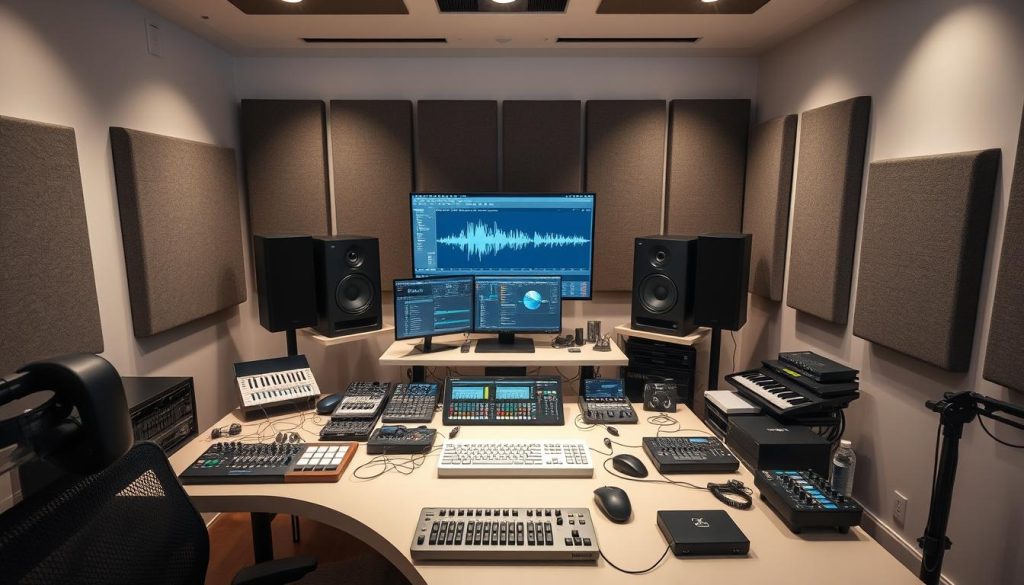
Choose a low-latency audio interface, an expressive MIDI controller, a microphone suited to the voice or instrument, and monitors with a neutral response.
“A balanced setup frees up creative energy and limits technical interruptions.”
| Item | Benefit | Recommended use |
|---|---|---|
| Ableton Live | Performance, clips | Live shows, improvisation |
| Cubase | Editing, professional mixing | Orchestration, post-production |
| Reaper | Lightweight, customizable | Efficient sessions |
| Bitwig | Modular design | Synthesis and sound design |
Practical rules: define your basic needs, test trial versions, compare online offers and check the plug-in ecosystem.
IRCAM’s documentary resources for musicians and researchers
The center’s media library is an essential starting point for anyone seeking archives, scores and specialist publications.
The Documentation Center builds and shares collections on contemporary music, the relationships among art, science and technology, and music research.

Media library: public access and archives of concerts and talks
A public access point for concert recordings, talks and scores. Educational guides and accessible articles help share knowledge with a wider audience.
Databases and portal: scores, research papers and accessible articles
The portal brings together subject-specific databases that can be searched by composer, work, technique or keyword. The collections include articles, technical records and project inventories.
Hours and services: Tuesday to Friday, 2:00–5:30 p.m.
The media library is open Tuesday to Friday, from 2:00 to 5:30 p.m. Support services include help with finding references, citation guidance and access to specialist collections.
“A documentation center where art, science and technology meet helps knowledge circulate.”
- On-site access to archives and data.
- Support services for researchers and musicians.
- Educational resources for the public.
Computer-assisted music and the music ecosystem: from research to industry
Computer-assisted production has reshaped creative paths and distribution channels.
Wider access rests on three factors: lower costs, intuitive interfaces and broader access to publishing platforms. These factors encourage the emergence of self-produced artists and a wider range of practices.
Wider access, business models and exchange
In the industry, platforms are changing revenue and promotion strategies. Streaming brings new formats and increasing pressure to be discovered.
The exchange between research and industry is clear: laboratory prototypes become tools for studios, stages and training. This connection stimulates innovation and adaptation.
- Artists who adopt music creation technologies renew the concert experience.
- Online exchange enables more international collaborations.
- Challenges include intellectual property, visibility and sustainable business models.
“New practices need institutional support to ensure their longevity and fair compensation.”
Conclusion
Since 1977, this institute has played a central role in musical creation by bringing research, development and artistic practice together over the long term.
The strength of the STMS joint research unit UMR 9912 lies in its seven teams and three areas of interaction. These structures produce models, techniques and systems that support composition and real-time experimentation.
Software, synthesis and acoustic approaches become practical tools for composers, musicians and artists. Through public engagement and online services, a wider audience can access the media library’s collections and the documentation portal.
Explore the databases, consult the online pages and speak with the teams to deepen your musical practice. This French ecosystem shows how science and creativity can advance together to bring new works into being.