

Welcome to this complete guide for beginners who want to explore the fascinating world of the handpan. This increasingly popular instrument is accessible even without any previous musical experience. Its intuitive design lets you play without knowing how to read music.
Throughout this article, we will introduce an effective way to make progress. You will explore essential topics such as how to hold the instrument, striking techniques, and practical exercises. We will also discuss how to choose your first handpan.
Our aim is to offer expert advice, including insights from David Charrier, who has brought together a community of 38,000 enthusiasts. Read to the end to discover the tips you need to get started.
1. What Is a Handpan? An Introduction to the Instrument
The handpan is an acoustic musical instrument in the idiophone family that first appeared in Switzerland in 2001. Its oval shape, reminiscent of a flying saucer, comes from two joined steel shells. This design gives it exceptional resonance and produces captivating sounds.
The upper shell has a central note called the ding, surrounded by several other notes that enrich the musical experience. These notes are arranged to encourage improvisation, making the instrument particularly accessible to beginners.
Players can use their hands or special mallets, with each technique producing a distinct sound. This flexibility contributes to the handpan’s growing popularity in music.
The instrument is also known by several names, including Hang, hang drum, pantam, and cupola. These terms reflect the diversity and appeal of this unique instrument.
Here are a few key things to know about the handpan:
- Accessibility: This instrument is ideal for beginners because it requires no previous musical knowledge or ability to read music.
- Intuitive playing: Thanks to its diatonic tuning, the handpan makes it easier to avoid wrong notes and begin learning.
- Ways to play: Players can use their hands for a gentle sound or mallets to vary the tone.
- Community: The number of handpan enthusiasts is growing, especially on social media.
- Rich sound: Shoulder tones and bottom notes add another dimension to the instrument’s sound.
The handpan offers a rewarding and emotional musical experience. As one enthusiast put it:
“The handpan is more than an instrument; it is an invitation to explore and feel music.”
To deepen your knowledge, you can find online resources, including video lessons and demonstrations. Learn more about these resources by visiting Sonodrum.
| Element | Description |
|---|---|
| Origin | Switzerland, 2001 |
| Family | Idiophones |
| Shape | Oval, similar to a flying saucer |
| Central note | Ding |
| Ways to play | By hand or with mallets |
| Accessibility | Ideal for beginners |
2. How to Position Your Handpan When Starting Out
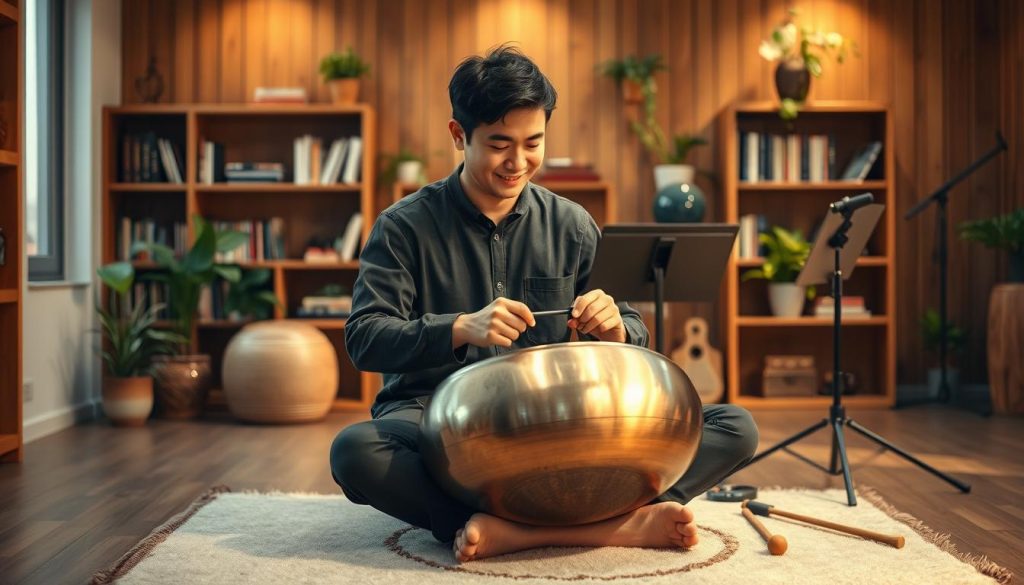
How you position your instrument is crucial to playing well. To begin, sit on a low chair, such as a camping chair. Your knees will then be slightly higher than your hips, helping you maintain good posture.
The handpan should rest on your thighs, tilted toward your torso. This position keeps it from slipping. Place the lowest notes near your stomach so you can reach every note without moving your torso.
Make sure you are comfortable in this position. You should be able to maintain it for a long time without pain. The instrument’s round shape may initially feel awkward. Here are some practical tips:
- Play while seated: Use a low chair to maintain good posture.
- Knee position: Your knees should be slightly higher than your hips.
- Tilt: Angle the handpan toward your torso to keep it from slipping.
- Orientation: Place the low notes near your stomach.
- Reach: Check that you can easily reach every note without moving your torso.
- Comfort: Find a position you can maintain without pain.
- Stability: Make sure the instrument rests securely against you so your hands can move freely.
- Adjustment: Adjust your position to suit your body.
- Avoid mistakes: Poor positioning can produce a muffled sound.
- Effect on sound: Good positioning directly affects sound quality and ease of playing.
Following these tips will help you play more easily and improve your sound. Try different positions to find the one that suits you best. Regular practice will help you become familiar with your instrument.
3. Essential Handpan Playing Techniques
Mastering playing techniques is essential to getting the most from this unique instrument. Despite what you might expect, playing involves gently brushing the handpan more than striking it. This approach preserves its vibrations and produces a rich, resonant sound.
3.1. Different Ways to Strike the Handpan
It is important to understand how to play each note. Here are some basic techniques:
- Light touch: Make a quick wrist movement to touch the surface without leaving your finger on it.
- Using your fingers: Use your thumbs for the closest notes, and your index and middle fingers for the others.
- Striking area: Play each note at the boundary between the tonefield and the dimple, on the ridge around the indentation.
- Ding: Play the central note, the ding, directly on its surface with a gentle touch.
Several advanced techniques can also enrich your playing:
- Ding tonefield: Strike the flat area surrounding the central ding.
- Fist: Use the base of a closed fist on the space between the notes.
- Knock: Strike the space between the notes with a knuckle.
- Palm mute: Place your palm on the ding to change its sound.
- Slap: Use the flat of your fingers on the space between the notes.
- Tak: Strike the ridge sharply.
- Finger roll: Make a quick roll with two or three fingers.
3.2. Hand Position and Playing with Both Hands
Good hand position is essential for producing varied sounds. Keep your hands light and relaxed, without pressing on the instrument between strikes. This will help your playing flow smoothly.
It is also important to develop your ability to use both hands equally. Your playing will become smoother and more balanced.
Regular practice of these techniques will improve your playing and help you explore the many sounds this fascinating instrument can make. Consult online resources to deepen your knowledge and develop your skills. To learn more, read this complete guide.
4. Simple, Effective Exercises for Steady Progress
Beginners can benefit greatly from targeted exercises to improve their playing. Here are some practical exercises to add to your daily routine.
Exercise 1: Start by playing all the notes on your instrument. Repeat each note hundreds of times. The goal is to play the notes with your eyes closed. This will strengthen the connection between movement and sound.
Exercise 2: Practice playing up and down the scale. Move from the lowest note to the highest, then reverse the order. This will help you learn to move between notes.
Exercise 3: Play chords by gently touching several notes at once. This will enrich your playing and help you discover pleasing combinations.
Exercise 4: Learn rhythms you invent or hear talented musicians play. Focus on one rhythm at a time before moving to the next.
Consistency is essential. Playing a little every day, ideally for 10 minutes, is recommended over one long session each week. This habit can produce noticeable, lasting progress.
Look to talented players on YouTube or in Facebook groups for new rhythms to try. Tutorials filmed from above make it easier to copy their movements.
Finally, try a playful notation system based on symbols and colors. It can help you learn rhythmic patterns without mastering complex music theory.
| Exercise | Description |
|---|---|
| Exercise 1 | Play every note until you can do it with your eyes closed. |
| Exercise 2 | Play up and down the scale to master transitions. |
| Exercise 3 | Play chords by gently touching several notes at once. |
| Exercise 4 | Learn rhythms one at a time. |
| Frequency | Practice for 10 minutes a day to make steady progress. |
5. Common Beginner Challenges and How to Overcome Them
Your first steps with the handpan can feel intimidating. Several challenges may arise as you learn. These are the ones beginners encounter most often:
- Striking technique: Learning to strike gently and accurately is essential. Using your fingertips helps produce a clear sound.
- Crosstalk: When one note unintentionally causes another to vibrate, it can disrupt the harmony. Choosing a good instrument helps limit this problem.
- Sustain: Excessive sustain can cause sounds to blend together and make your playing unclear. Learning to manage it helps preserve clarity.
- Adapting to the scale: Each instrument has its own scale. Understanding which notes work well together is essential to making progress.
- Frustration: Beginners can feel stuck when they keep playing the same things. This can limit their creativity and motivation.
To deal with these challenges, accept that learning takes time. Do not expect to master the instrument in a few weeks. Here are some ways to overcome these obstacles:
- Choose a good instrument: Investing in a quality handpan can make learning much easier.
- Vary your exercises: Explore different techniques and melodies to avoid monotony.
- Film yourself: Recording your practice sessions can help you see your progress and adjust your technique.
- Join a community: Forums and Facebook groups let you ask questions and exchange advice.
- Remember: Even renowned artists faced difficulties when they started. Perseverance is key.
As a famous musician said:
“Music is a journey, not a destination.”
6. How Long Does It Take to Learn the Handpan?
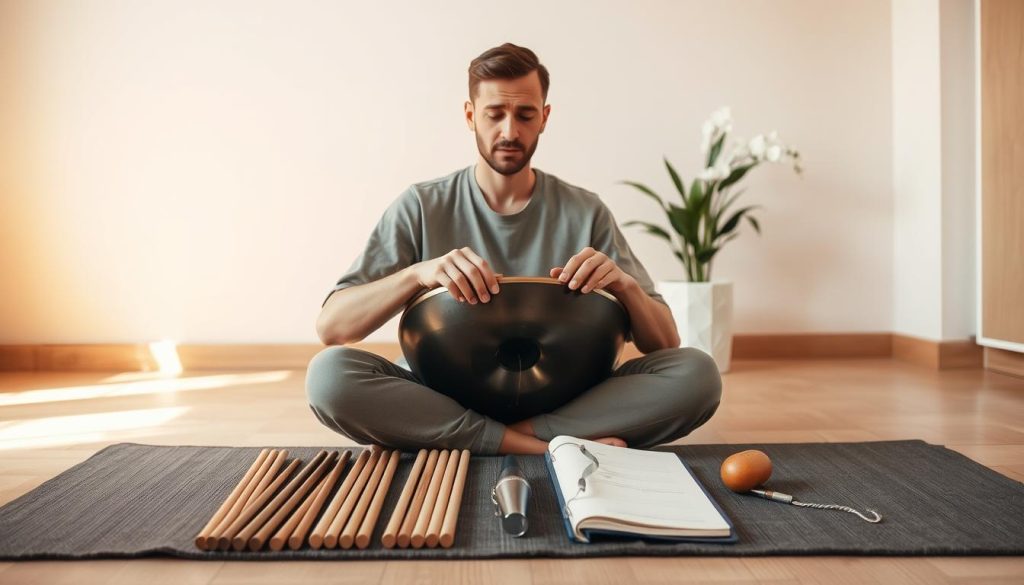
The time needed to master this fascinating instrument varies considerably from person to person. Each player learns at their own pace, depending on factors such as natural aptitude and previous musical experience.
In general, it is realistic to expect to learn the basics in a few weeks. With regular practice, around 20 hours may be enough to become an independent handpan player with a reasonable level of skill.
Learning resources such as books and videos play an essential role. Practical advice and suitable techniques can shorten the learning process. Daily practice is also more effective than long sessions spaced far apart.
Reaching an advanced level takes several months or even years of dedicated practice. The handpan is known for being easy to start playing but difficult to master fully, like any musical instrument.
Here are some points to consider about learning time:
- Realistic estimate: You can learn the basics in a few weeks with regular practice.
- Reasonable skill level: Around 20 hours of practice may be enough to play independently.
- Key factors: Natural aptitude, previous musical experience, and the use of learning resources.
- Advanced mastery: Several months or years of dedicated practice are needed.
- Learning resources: Books, videos, and online courses can considerably shorten the learning process.
- Importance of consistency: Daily practice is more effective than occasional sessions.
- Testimonials: Students using the MasterTheHandpan method report noticeable progress in a short time.
- Compared with other instruments: The handpan can produce satisfying results sooner.
- Personal progress: Do not compare yourself with others; measure your own progress.
As one student said:
“I never thought I could play so well so quickly. It is incredible to see how far I have come.”
In short, regular practice and suitable resources are the keys to success. Get started and explore this captivating instrument. For more advice, read this complete guide.
7. How to Choose Your First Handpan
Choosing your first instrument can be a decisive step in your musical journey. Consider several factors, including its scale, number of notes, and materials.
7.1. Main Scales and How They Affect the Sound
Scales play an essential role in your instrument’s sound. Major scales often sound cheerful and upbeat, while minor scales add a melancholy touch. Eastern scales offer ethereal, mystical sounds.
A D minor scale is often recommended for beginners. It is versatile and easy to learn. Before choosing, listen to different scales on YouTube or in recordings provided by makers.
7.2. Number of Notes and Materials
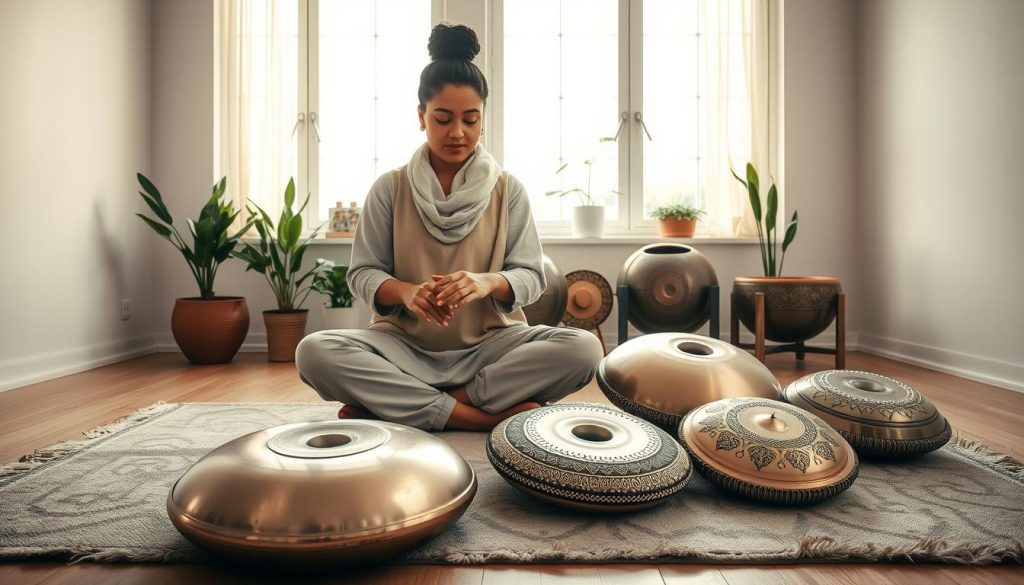
The number of notes is another essential consideration. A nine-note handpan (eight notes plus the ding) is ideal for beginners because it is quick to learn. For intermediate or experienced players, an instrument with 10 or more notes offers more possibilities.
Two types of steel are commonly used: nitrided steel and stainless steel. Nitrided steel produces a warmer, richer, deeper sound, while stainless steel offers a brighter sound with less sustain.
Price is important when buying. A poor-quality handpan may cost between €1,200 and €2,500. Do not judge quality by price alone. Key criteria include balanced notes, minimal crosstalk, and an ideal sustain of 8 to 12 seconds.
Finally, the instrument’s color is a matter of personal preference and does not affect its sound. It may, however, increase your enjoyment of playing. Check the warranty (12 months at Handpan France) and the 14-day withdrawal period before completing your purchase.
| Criterion | Details |
|---|---|
| Scale | Major, minor, and Eastern |
| Recommended scale | D minor for beginners |
| Number of notes | Nine notes (eight plus the ding) for beginners |
| Materials | Nitrided steel and stainless steel |
| Price | €1,200 to €2,500 for varying quality |
| Ideal sustain | 8 to 12 seconds |
| Warranty | 12 months at Handpan France |
| Withdrawal period | 14 days |
8. Learn to Play the Handpan: A Simple Way to Get Started
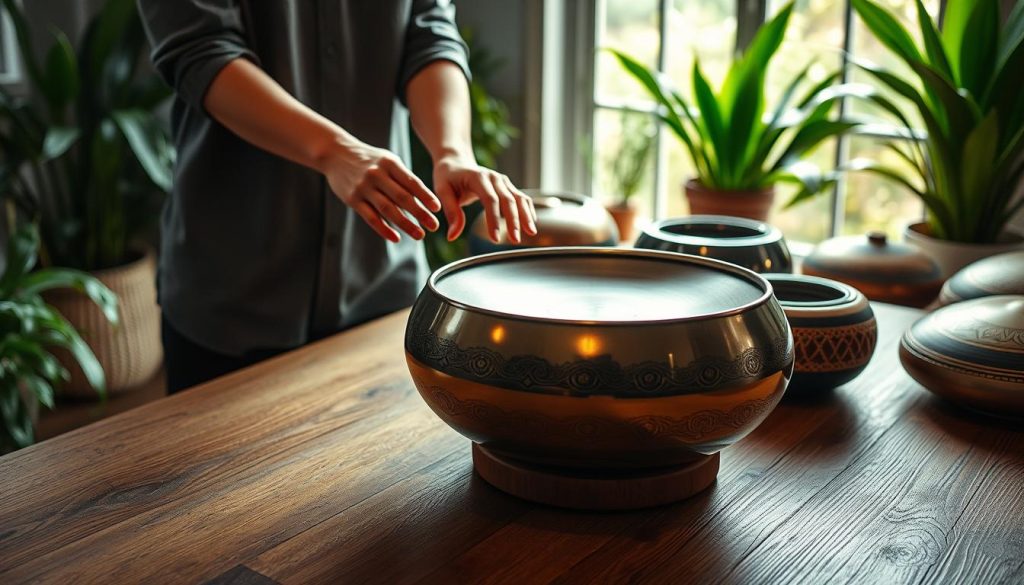
Discovering the stages of learning the handpan can transform your musical experience. The MasterTheHandpan method offers comprehensive training that helps people progress at their own pace.
8.1. Step-by-Step Progress for Beginners
The course is organized into clear lessons that help students master each aspect of the instrument. Immersive videos filmed from above show the teacher’s left side on the same side as the student’s. This prevents confusion while learning.
A notation system uses symbols, colors, and numbers. It makes learning accessible even without the ability to read music, so players can focus on enjoying the experience.
A downloadable, printable ebook is also included. It lets students practice anywhere, even without an internet connection. Each student can see their progress and move forward at their own pace.
8.2. Recommended Learning Resources, Courses, and Tools
David Charrier guides students with more than 10 years of experience. A worldwide community of 38,000 players reflects the method’s effectiveness. Joining a community of enthusiasts offers opportunities to exchange ideas and share the pleasure of music.
The platform is available on computers, tablets, and phones, letting you play anywhere, anytime. Two options are offered: lifetime access to an individual course or an Unlimited Pass with access to every course and masterclass.
The Unlimited Pass also provides access to a private community, live workshops, challenges, coaching, and webinars. A 14-day money-back guarantee is offered so you can try the method without risk.
This method works with all handpans and tongue drums, regardless of their scale or number of notes. Student testimonials highlight its clarity, the motivation it inspires, and the quick progress they make. It lets you enjoy learning and soon create your own variations and melodies.
| Feature | Details |
|---|---|
| Course format | Immersive videos filmed from above |
| Notation system | Symbols, colors, and numbers |
| Included material | Downloadable, printable ebook |
| Access | Computer, tablet, and phone |
| Options | Individual course or Unlimited Pass |
| Community | Access to live workshops and challenges |
| Guarantee | 14-day money-back guarantee |
9. Practical Tips for Staying Motivated and Making Progress
Staying motivated is essential to improving at the handpan. Most beginners face challenges, but there are simple ways to overcome them. Here are some practical tips to keep learning.
Establishing a daily routine, even a short one of 10 minutes, helps you make steady progress. Consistency is more useful than long sessions spaced far apart. Playing every day will quickly help you get to know your instrument.
Varying your exercises and musical styles is also important for avoiding monotony and stimulating creativity. Explore different genres to enrich your playing and discover new sounds.
Joining a community of players, online or in person, is a great way to share your experience and stay motivated. Taking part in challenges and live workshops, such as those offered by MasterTheHandpan, can also inspire you and help you improve.
Set realistic short- and medium-term goals to measure your progress. By filming yourself regularly, you can see how you have developed and identify areas to improve.
Investing in quality training can also speed up your progress. A structured course can help you learn more effectively than scattered resources.
Finally, remember to enjoy playing. The handpan is an intuitive instrument well suited to improvisation and relaxation. Accept the periods when progress seems to stall, as most players experience them, and persevere patiently. Treat your instrument like a member of your musical family, giving it regular attention and practice.
Here is a summary of these tips:
| Tip | Description |
|---|---|
| Daily routine | Play for 10 minutes a day to keep improving. |
| Variety | Explore different musical styles to stimulate creativity. |
| Community | Join player groups to share experiences and exchange ideas. |
| Challenges | Take part in workshops and challenges to stay motivated. |
| Goals | Set measurable goals to track your progress. |
| Recordings | Record yourself to assess your development and find areas to improve. |
| Training | Invest in quality training to make faster progress. |
| Enjoyment | Enjoy playing and improvising on the instrument. |
| Patience | Accept periods of slow progress and keep going. |
| Musical family | Consider the handpan a member of your musical family. |
10. Conclusion
The handpan offers a unique musical experience worth exploring. This intuitive instrument is accessible to everyone, but learning to play it requires a striking technique and a sense of rhythm.
You can teach yourself, but beginners often find this a long and difficult path. A structured method, such as a book or video course, is recommended for faster progress.
Quality training, available for around thirty euros, can save hours of unproductive practice. The Instruments du Monde store offers a complete book with advice, tutorial videos, and 25 pieces of sheet music.
Handpan France also offers a 12-month warranty and a 14-day withdrawal period, which may reassure buyers. Choosing the right scale and number of notes for your first instrument is essential.
Finally, practice regularly, join a community, and enjoy playing. The handpan invites you on a musical journey that encourages well-being, relaxation, and a connection with yourself.